
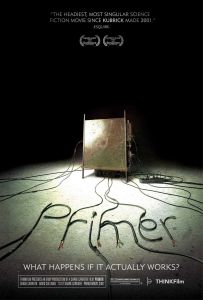
Four friends spend their spare time working on science projects in one of their garages, but when two of them accidentally discover time travel will their friendship and trust in each other remain?
Full disclosure, at the moment in the UK you will need to rent or buy Primer via Amazon TV. I sought it out following the release of Tenet, the biggest blockbuster in recent years related to moving backward in time as I wanted to revisit arguably the most complicated scientific approach to that concept in film.
Primer was made in 2004 almost single handed by first time film maker Shane Carruth. With the paltry budget of $7,000 Carruth gave himself the roles of writer, director, producer, cinematographer, editor, composer and lead actor and then employed friends and family to fill the small cast. Carruth was a former software engineer with a degree in mathematics and wanted to create a film that was filled with language that scientists and engineers would actually use. To help with this he studied physics in order to write the dialogue and script.
The plot focuses on Abe (David Sullivan) and Aaron (Shane Carruth) and the actions they take when they accidentally discover a way to travel backwards in time. As the plot becomes clearer and the complicated layers of timelines become apparent the film becomes more rewarding to watch.
Primer is an odd film in that I thoroughly recommend watching it but can not with any certainty expect you to enjoy it. The budget does have a tangible impact on the quality of the image and film making with grainy images and poor lighting cropping up often. The script also makes it initially hard to follow what the characters are even doing and neither of the leads have been written in a sympathetic light. Without the trappings of charismatic actors, sympathetic characters, exposition and perfect production there is a barrier that the audience will need to break down in order to engage fully with the film. On the other side of the coin though, at only 77 minutes long this is not a film that requires a huge investment of your time. And if you are able to overcome that barrier there is a fascinating, very complex story to uncover. In fact, I fully recommend that once you have watched the film you analyse one of the many infographics that you can find online that attempt to explain the multiple timelines of the film and the ramifications of time travel on them. I can guarantee that your understanding of the film on first watch will not quite fully grasp the complexity hidden within the film and you may well find yourself watching it again just to see if you can understand it that little bit more.
A cult classic, a flawed piece of film making but vital and fascinating.
 Phil the Bear's Film Reviews