
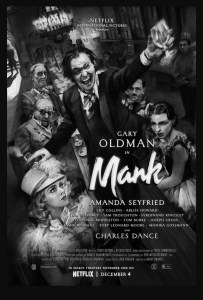
It is 1940 and Herman J. Mankiewicz (Gary Oldman) has been sequestered to a ranch in the Mojave desert by Orson Welles (Tom Burke) for the purpose of writing the script to his debut film. As he writes the screenplay for arguably the greatest film ever made Mank recalls the moments in his life that led to the creation of Citizen Kane.
Mank begins as a down and out alcoholic. Recovering from a car accident and in a cast from the waste down he is bed bound and has a permanent live in nurse and secretary in order to keep him from alcohol and type his thoughts. In such desperate need for this final job he even agrees to forego screen credit for the gig. As his story unfolds and he gets more and more of a grasp on his convoluted multiple flashback filled script we see Mank slowly restored to what we can only imagine is his prime. His craft saving him from his self destructive qualities, if only for a brief time.
Gary Oldman recently won the Oscar for Best Actor in a Leading Role for Darkest Hour but this should be the performance he is remembered for. Mank is a desperate alcoholic constantly sabotaging himself. Unable to keep his thoughts to himself despite the powerful people in his presence who could destroy his career. But his forthrightness is always based in the morally right position and his despair is at not being able to influence the world around him to move onto the correct path.
David Fincher’s latest opus could easily be seen as his most personal film and almost semi-autobiographical. Fincher’s debut feature was Alien 3 and he has spoken openly about the hell he experienced due to studio interference and as a result has had final cut on all of his films since Panic Room. The fact that Citizen Kane inspired a newspaper mogul to try and destroy it and that Welles and Mank had a bitter feud over credit must have really spoke to him. Then of course there is the fact that Fincher’s late father Jack wrote the screenplay which must have made it a personal passion project for him.
At this point in time it is hard to imagine Fincher being able to make this movie in the current cinematic landscape without Netflix. Or Netflix International Pictures for the purposes of this film. And I think all fans of film should be thanking Netflix for giving Fincher free rein here. The film is shot in glorious black and white, features the speech pattern and intonation of films of the era it is set, typed script cues appear on screen to signify what flashback period we are in and many shots and sequences are reminiscent of Citizen Kane including split diopter shots (where objects both close and far away from the camera stay in focus) and a recreation of a its famous opening. The plot also follows Kane’s flashback structure to tell its own story. It could easily be described as a love letter to Hollywood and Kane if it was not for the fact that it delves into the down and dirty grubby behaviour rife in the industry.
Aside from Oldman there are some other stand out performances worth mentioning. Tom Burke joins the list of actors to take on the formidable task of portraying the late great Orson Welles and does a fantastic job. Welles appears fleetingly, but when he does Burke is imposing and nails his unique sonorous voice. It was especially surprising to find out that Burke is thirty-nine years old given he is portraying a twenty-four year old man so well. Charles Dance gives an assured performance as newspaper magnate William Randolph Hearst, whom the character of Charles Foster Kane is based on. His ability to dominate the room with just a look is well used here and for anyone unfamiliar with the story of Kane and Hearst should do some cursory investigation before watching. And then there is Amanda Seyfried as Marion Davies, Hearst’s mistress. Seyfried is perfect as a multifaceted woman who is a movie star in her own right, sympathetic to Mank’s politics but also tied to her fame and love of Hearst.
Fincher has also called upon his now regular collaborators Trent Reznor and Atticus Ross on scoring duties and they deliver a brilliant 1940’s film accompaniment to the crisp pictures.
So of course we have an instant classic on our hands? In my mind, yes. But as ever I try to give a fair appraisal when I discuss films so here is fair warning. My wife could not even make it to the half hour mark of the film saying simply. “this is not for me”. And I suspect that if you have no knowledge or interest of Citizen Kane, the real life newspaper magnate William Randolph Hearst who inspired that film or 1940’s cinema you might struggle. I really do think this is a masterpiece but I suspect you might need to arm yourself with some information before you dive in. At the very least you might need to watch The Simpsons episode Rosebud for the Cliffs Notes on Kane!
David Fincher’s latest masterpiece is now streaming on Netflix.
 Phil the Bear's Film Reviews
3 thoughts on “Mank”