
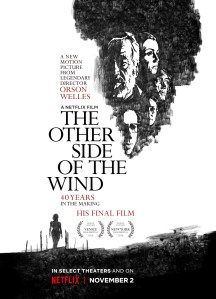
Legendary filmmaker Jake Hannaford (John Huston) is in the process of trying to complete his experimental movie The Other Side Of The Wind. On his birthday in an effort to secure more funding for the film he has a party populated by many people from fans, hangers on, industry members and prospective financiers.
The Other Side Of The Wind is Orson Welles final movie completed over thirty years after his death. Pieced together from over one hundred hours of footage by editor Bob Murawski, Welles daughter Beatrice and friend Peter Bogdanovich, who also appears in the film. The making of the film is chronicled in They’ll Love Me When I’m Dead.
This film could easily be seen as a semi-autobiographical story for Welles. Hannaford is a legendary director, full of confidence and quick to put down people with witty barbs. He also is clearly struggling to complete a film due to financing and is making it on the fly. Peter Bogdanovich plays director Brooks Otterlake, a close friend of Hannaford. Bogdanovich of course is a film director who was a close friend of Welles.
The story itself and the manner it is put together is incoherent and jarring. The film stock changes regularly, the images switch from black and white to colour, the editing is frenetic and the shots are filled with close ups and zooms. The entire thing feels like a hallucination or fever dream.
At one point just before the hour mark the film within the film is played for the party attendees and I would not be surprised if the average viewer checks out at this point. Hannaford’s experimental feature which stars Orson Welles mistress Oja Kodar, who spends much of it naked has zero coherent narrative.
John Huston, himself a famous director does give a brilliantly acerbic performance. Although be warned that some of his insults and jokes feature incredibly dated slurs. Remember this was filmed in the 1970’s.
Ultimately I really could only recommend this to people interested in Welles himself as a curiosity. Is this 122 minute experiment the film he would have created if he had edited it together? Or was his purpose to never finish it in the first place to mirror the plot of the film? Either way I think the more interesting story is the one presented in the aforementioned documentary ‘They’ll Love Me When I’m Dead’.
 Phil the Bear's Film Reviews