
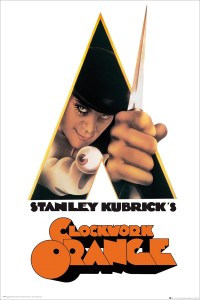
Alex (Malcolm McDowell) and his droogs Pete (Michael Tarn), Georgie (James Marcus) and Dim (Warren Clarke) like nothing less than spending their nights committing some ultra violence. After Alex murders one of their victims he is sentenced to fourteen years in prison so he volunteers for a revolutionary treatment that could see him a free man.
Receiving a 4K restoration, A Clockwork Orange is back on cinema screens for its 50th anniversary. An all time classic that still has not lost any of its sheen it is fantastic to see it again on the big screen. The first time I saw this film was in 1999 on its re-release in UK cinemas. In fact I was lucky enough to be working at a cinema that had a mini Kubrick season that included 2001: A Space Odyssey, The Shining and Full Metal Jacket. At the time it felt like a huge moment in cinema for me. This banned film (it actually was withdrawn in the UK at the request of Kubrick, rather than banned) was finally able to be seen and I could do so at the cinema.
Whilst known for its violence it is actually far more interested in the themes of free will, the overreach of government control and the use of psychological aversion therapy. That is not to say the violence is not still striking, especially in the sexual violence where Alex and his gang gleefully take part in rape and sexual assaults.
The opening half of the film is perhaps its most successful. The language used by Alex and his thugs is a mixture of Russian and Cockney rhyming slang that gives the film an almost Shakespearean lilt to the rhythm of their speech. Add this to the set design and costumes and you have a dystopian society in the not too distant future that still seems realistic fifty years on. Scenes where Alex woos two women from a music shop and those set in the Korova milk bar are incredibly memorable and striking.
The second half of the film focuses on how a government desperate to keep control are focusing on radical measures to reduce crime. It struck me on watching it this time that the government we see in 2005’s V For Vendetta seems very much the continuation of where this one might arrive at. The questions raised here are whether psychiatric aversion therapy is morally right when used to change the nature of a person. Can a person truly be good if they are conditioned that way? And does the government have the right to intervene to these lengths?
A fantastic score, striking imagery, a brilliant lead performance from McDowell, dark humour and some moral conundrums. Kubrick was one of the best and this is one of his best.
 Phil the Bear's Film Reviews