
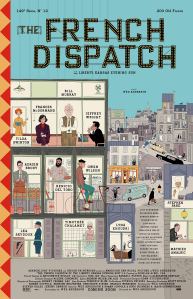
When Arthur Howitzer Jr. (Bill Murray), editor of The French Dispatch, dies suddenly of a heart attack his employees set out to enact the wishes of his will. One final edition of the magazine will be produced and act as his obituary before the printing presses are melted and the staff disbanded.
Set in the town of Ennui, France the film is structured in the format of this final magazine. It begins with a short ode to the town as written by Herbsaint Sazerac (Owen Wilson) before moving on to three stories written by its leading investigative journalists.
The Concrete Masterpiece by J. K. L. Berensen (Tilda Swinton). The story of a murderer (Benicio Del Toro) inspired by his prison guard (Lea Seydoux) to create art and the art dealer and fellow inmate who tries to get rich from it (Adrien Brody).
Revisions To A Manifesto by Lucinda Krementz (Frances McDormand). The story of a student revolution in the town of Ennui lead by Zeffirelli (Timothee Chalamet) and Krementz efforts to remain a neutral observer and retain journalistic integrity.
The Private Dining Room Of The Police Commissioner by Roebuck Wright (Jeffrey Wright). The story of how Wright attends a dinner at the police commissioner’s (Matthieu Amalric) home only for his son to be kidnapped and a hostage situation unfold.
The French Dispatch or to give it its full title; The French Dispatch of the Liberty, Kansas Evening Sun is perhaps the most “Wes Anderson” movie of all of Wes Anderson’s films. His trademarks are all present and correct here and in the parlance of Spinal Tap, dialled up to eleven. Symmetrical framed shots, title cards and chapters, montages, dysfunctional families, children who behave like adults, distinctive camera movements, distinctive language and his now large ensemble of repertory actors. The result is utter perfection for his fans, of which I am unashamedly one.
If you want to read my thoughts on his other works you can do so here – Wes Anderson Retrospective or even listen to them here – At the Flicks Podcast – Wes Anderson. If you are an Anderson sceptic then there will be nothing here to change your mind. Otherwise I want to spend a little time explaining why this film is an utterly joyful delight.
The main trigger for the story is the death of the patriarch of the magazine’s dysfunctional family of writers and staff. Resulting in us looking at three stories from its most famous journalists. Consider how this is similar to The Darjeeling Limited where three brothers reunite one year after the death of their father.
The first story revels in the art world something that is dotted throughout Anderson’s films. Whilst his films themselves are works of art, they often feature artists and paintings.
The second story focuses on protest in a made up country in Europe (The Grand Budapest Hotel) and features a play within the story (Rushmore).
Whilst the third story features the most ludicrous of chases that turns into an animated feature just like Fantastic Mr. Fox and Isle of Dogs.
Elsewhere look out for a plane set that will remind you of the submarine in The Life Aquatic, unknown narrators and a new take on Anderson’s usual slow motion scenes whereby the actors all freeze as the camera pans across them during key moments.
The film is bursting at the seams with Anderson’s witty attention to detail just as it is with hoards of A list actors who seemingly will appear for a couple scenes and barely a line just to work with him. Saoirse Ronan, Edward Norton and Willem Defoe are a few of many that fit this bill here.
And there are some beautiful performances in here as well. Benicio Del Toro and Lea Seydoux are startlingly good as artist and muse in the first tale. Whilst Jeffery Wright probably stole the film for me as the lonely writer of the third story. (Note that Christoph Waltz appears in the second story as well to make the Bond reunion a little more noticeable)
Just as the film acts as a love letter and eulogy to journalism in the form of Bill Murray’s editor this film could easily do the same for Anderson’s inimitable style.
 Phil the Bear's Film Reviews
4 thoughts on “The French Dispatch”