
On the 1st October 1997 I was a teenager working at UCI cinemas and thoroughly utilising my staff perks of free tickets. At the time the cinema chain held “Directors Chair” screenings every week which usually consisted of a classic film or a more obscure art house release. I made it a point to go to every single screening and it was very often a highly rewarding experience. On this particular day the screening was of The Spanish Prisoner and I was completely blown away. I loved it instantly and was spellbound by the tricks it played on its protagonist and in turn the audience.
Unlike a lot of the other directors I have conducted retrospective projects on, despite that initial excitement at a particular film I did not track down all of Mamet’s films. In fact of the eleven films in his directorial back catalogue I had only previously seen four prior to this article. Interestingly though, three of those films are films I had seen multiple times. The aforementioned The Spanish Prisoner, Spartan and one of my most played DVD’s, State and Main.
The aspect of Mamet’s films that draws me to them the most is his scripts and what has been defined as “Mamet Speak”. His dialogue is precise, gritty and delivered at speed by his actors, most of whom work regularly with him or his works. The current film maker whom is most obviously likely to draw parallels is Aaron Sorkin, who also has an incredibly distinctive voice. When you watch a film written by them you will recognise the distinctive speech patterns that they give their characters.
Mamet started his career as a playwright and won a Pulitzer Prize for his play Glengarry Glen Ross. His plays also include the critically lauded American Buffalo, Lakeboat, Speed The Plow, Oleanna and Sexual Perversity In Chicago. He most recently had a play staged in LA in 2020 called “The Christopher Boy’s Communion” starring William H. Macy (a regular collaborator). Mamet has also been a prolific screenwriter and whilst those films do not fall into the purview of this article as it focuses on his directed films there are some absolute classics amongst this work, including; The Postman Always Rings Twice, The Verdict, The Untouchables, Glengarry Glen Ross, American Buffalo, Wag The Dog and Ronin. It should not come as a surprise when I tell you that all eleven of his directorial efforts that I will cover here were also written or adapted by him.
One thing that is immediately apparent when you watch his films, especially his earlier ones is the amount of recurring actors you see throughout. Ricky Jay and Jack Wallace appear in 7 of his 11 films whilst William H. Macy and Rebecca Pidgeon appear in 6 in much more predominant roles and Joe Mantegna appears in 4 including the lead role of his first 3 films. Pidgeon is Mamet’s second wife and also is credited with the music in Oleanna. Mamet’s first wife Lindsay Crouse is the lead in his debut film as well.
House Of Games (1987)
Dr. Margaret Ford (Lindsay Crouse) is a famous psychiatrist who specialises on the subjects of obsession and compulsion. When one of her patients threatens to take his own life because he owes $25,000 to a gambler named Mike (Joe Mantegna) she takes it upon herself to visit the pool parlour he operates from named The House Of Games. Mike attempts to con her but she foils his plan and they end up spending the evening discussing the art of the con and how it relates to her profession. Fascinated by the entire subject she asks him if they can spend more time together and that perhaps she can use his knowledge as the basis for a new book.
What follows is a fascinating insight into the art of the con and obsession featuring the kind of precise and intelligent dialogue that Mamet is known for. The scene where Mike explains to Margaret that a con is all about the con artist lending the mark their confidence and how they go along with it if they are getting something from the transaction is perfect as a summation of the entire plot of the film.
Mamet’s first film may well be his best. The story keeps you constantly on your toes because you are never entirely sure what is genuine and what the motives of either of the two leads is at any time. Joe Mantegna and Lindsay Crouse are wonderful together and the way they deliver the lines is like a perfectly choreographed dance.
The supporting cast includes William H. Macy, Ricky Jay, J.T. Walsh, Jack Wallace and Mike Nussbaum are highly believable as a bunch of conmen and their associates. Many of whom will form part of Mamet’s acting troupe across his films.
Stylistically the film is sparse but effective. Margaret’s office looks like any other, whilst the bars that Mike frequents look fairly unwelcoming and well lived in. There is nothing over the top about the locations, camera movements or score. Everything is as efficient as it needs to be to serve the dialogue and plot.
House of Games would go on to win the Best Film and Best Screenplay awards at the Venice Film Festival when it debuted there and even now, thirty-five years later it holds up as a riveting crime thriller.
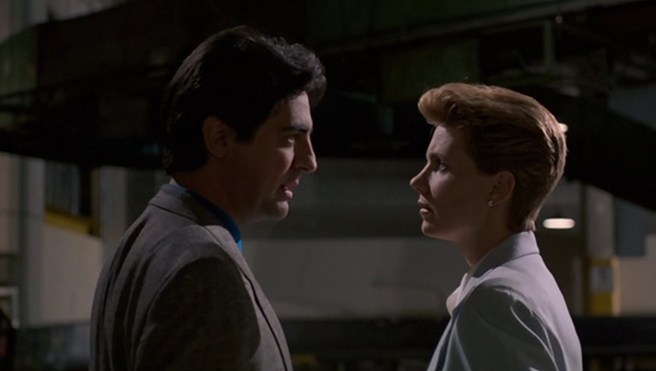
Things Change (1988)
Gino (Don Ameche) is an Italian-American shoe-shiner who has a striking resemblance to a mafioso who just killed a man. So he is made an offer that he cannot refuse. Take the blame and be paid for every year he has to serve in prison so that he can realise his dream of one day owning a fishing boat. Jerry (Joe Mantegna), a low level mafioso who is on probation for a misstep we are not aware of, is given the job of babysitting Gino over the weekend before he can appear in court to accept his guilt. If Jerry can get this task right he will be able to resume normal duties. But when Jerry takes Gino to Lake Tahoe for a nice send off, Gino is mistaken for a high level mob boss.
Things Change is the only film that David Mamet has directed that was not solely written by him and it is perhaps for this reason that it feels very different to his other works. Co-written with Shel Silverstein, Things Change is not your typical mafia film in any way shape or form and is very much about the bond of friendship formed between two men.
As far as plot and story goes it is incredibly slight. My synopsis pretty much covers everything that the film guides you through in terms of plot points. But where it really comes into its own is in the interactions and chemistry between Ameche and Mantegna. We watch their friendship grow and their bond develop. And it is this friendship that changes them both and makes their outlook on life change.
Mamet’s hard edge is gone. Instead there is a wistfully light comedy featuring two brilliant lead performances that will warm your heart.

Homicide (1991)
Detective Bobby Gold (Joe Mantegna) is on his way to potentially the biggest case of his life. The FBI have failed to catch a brutal killer (Ving Rhames) and Bobby has a lead. But on the way he and his partner Tim Sullivan (William H. Macy) get caught up in a small time case. A Jewish corner shop has been robbed and its owner murdered. The department and the family of the victim think it is only right that a Jewish cop investigate the murder of one of their own.
David Mamet has essayed confidence tricks many times in his films, but in Homicide it seems as though he is the trickster. Everything about this film tells you that it is going to be about a hard boiled detective who gets the job done any way that he can. But that is not what the focus of the film is. Its focus is identity and finding where you belong.
Gold maybe Jewish but he does not identify as one. He identifies first and foremost as a cop. But when he is pushed away from the case he wants to be a part of and finds the case that he is now on leads him to an anti-Jewish conspiracy he starts to believe that perhaps he can belong again. The issue is that his need to fit in entirely clouds his judgement and results in him not fitting anywhere.
Homicide has some striking scenes, takes you down avenues you would not believe and has an incredibly brutal and downbeat ending. Whilst the whole thing is uplifted by Mantegna and Macy, both ever present in all of Mamet’s films to this point and veterans of stage work with them spitting lines back and forth at each other like they have worked together for decades.
Some scenes of note include the moment that Gold is spitting anti-Semitic vitriol down the phone whilst unbeknownst to him the victim’s granddaughter sits quietly in the back of the room (Mamet’s second wife Rebecca Pidgeon making her first of many appearances in his films). The scene where Gold uses his hostage negotiating skills to talk the mother of a criminal to give him up shows us how Gold is able to project different personalities to fit into the moment he is in. Whilst the absolute stand out is an exchange between Gold and a prisoner in the precinct he works in. The prisoner shouts at him, “Don’t you want to understand the nature of evil?”, to which Bobby replies, “no, because then I wouldn’t be able to do my job.” And then of course there is the final scene where Bobby realises what his need to fit in has got him.
Stylistically Homicide is probably Mamet’s best film to date with Roger Deakins behind the camera. But it does include his first foray into attempts at action scenes which look wooden at best and lack any sense of real excitement or fluidity.
This was Joe Mantegna’s third consecutive lead role for Mamet and whilst the film may not be quite as good as the debut this performance might well be Mantegna’s best.

Oleanna (1994)
Carol (Debra Eisenstadt), a university student, has gone to the office of her teacher John (William H. Macy) to discuss the frustration she has with not understanding his course. John is distracted by regular phone calls from his wife during their conversation about the fact that he needs to come to the house they are trying to buy as some issues have cropped up. Initially John is frustrated with Carol and belittles her before he gradually warms to her seeing something of himself in her. He offers to give her an A grade if she will agree to return to his office for private lessons.
Their second meeting sees John desperately trying to reason with Carol over the sexual assault allegations she has made against him. The allegations could result in the tenure review board turning him down which in turn would financially make him unable to close on the house.
Finally their third meeting in his office plays out the outcome of events and what they have driven each other to.
Oleanna is an absolutely fascinating film based on Mamet’s own play. It is a two handed play set in one location with three clear acts. Each act is a meeting between the two characters where an unnamed amount of time has passed since their last meeting. The absolutely crucial facet of the story though is the ambiguity of the events in the first act that result in every one who watches it being forced to take their own position on what happened. Who is the wronged party in the story?
When I watched the film I have to admit to having a very strong reaction in favour of one of the characters. Which character that was I will elect not to say. But at the end of the film after reading other peoples perspectives of the events I watched parts of the first act again to see if I really only saw what I wanted to see and to try to see them from that other angle. I could easily envisage the film/play causing arguments between people who have gone to see it together and am in awe of quite how perfectly written and presented it is based on that perception.
The acting is superb throughout. William H. Macy who has appeared in Mamet’s previous three films in various supporting roles is now the lead taking on the role that he originated on the stage for Mamet. Whilst Carol is portrayed by another star of the play Debra Eisenstadt (Mamet’s wife Rebecca Pidgeon originated the role alongside Macy but here can only be heard singing the opening and closing music).
But despite all this, Oleanna is a classic example of an adaptation of a play that fails to transcend the medium. The film, despite its best efforts is static and drab and for all intents and purposes is a play that has just been filmed. The result across the 89 minute running time is that it can be a difficult watch. Watching two powerful actors have an intellectual back and forth on stage with the visceral nature of it being live and in person is a fundamentally different prospect to watching on the screen, especially a smaller one at home. Which is a shame because the subject matter is incredibly intriguing.
In case you were wondering, the title of Oleanna refers to a utopian community founded in New Norway that ended in complete failure.

The Spanish Prisoner (1997)
Joe Ross (Campbell Scott) has developed a lucrative secret process for his company that stands to make them millions. Whilst on a Caribbean island where he has been sent to help sell the process he meets the incredibly affluent Jimmy Dell (Steve Martin) who he strikes up a friendship with.
Ross also meets and befriends a new company secretary whilst on the trip called Susan (Rebecca Pidgeon) who takes a liking to Ross and fills his head with the idea that people are not always what they seem. The fact that Ross is concerned about the company’s plans to remunerate him not matching the value of what he has created both Jimmy and Susan offer assistance in different ways.
Then when Ross returns to New York his continued friendship with Jimmy and Susan influence his position even further. But absolutely nothing is what it seems when it comes to corporate greed.
For me, The Spanish Prisoner is Mamet’s second best film but when it comes to confidence tricks it is the all time best. Featuring a brooding and imposing score from Carter Burwell, a labyrinthine plot featuring short, sharp and punchy dialogue delivered by an excellent cast and a resolution that is wholly satisfying it is an absolute joy to watch on every level.
The script is an absolute belter with every interaction between characters having real heft and impact on either their personal behaviour or propelling the story. There is little to no fat or embellishments here that bloat the plot in anyway. On multiple watches of the film there are still moments where I find new and deeper understanding of all the twists and plans happening behind the scenes. Steve Martin, Campbell Scott and Rebecca Pidgeon are all sensational as well. When I first watched the film I do not think I had seen Steve Martin in a dramatic role and I remember being incredibly impressed that one of the Three Amigos was such a good actor and his performance still stands out today. But there are also a string of supporting roles that add immeasurably to the film such as that of Ben Gazzara, Ricky Jay and Ed O’Neill.
If I had to be critical on any level there are only two issues to raise. Firstly, made on a budget of only $10 million it can at times look perfunctory and secondly, Mamet can still not direct action and the one scene that requires it here looks clunky at best. But these are incredibly picky and cosmetic issues when the excellence is in the script and the performances.

The Winslow Boy (1999)
Ronnie Winslow (Guy Edwards), a young naval cadet is found cowering in his back garden in the rain when he should be at his naval college. He has been expelled for stealing a postal order, a crime which he insists he did not commit. His father Arthur (Nigel Hawthorne) is not prepared to have his family name sullied by the accusation and mounts a defense against the expulsion. Firstly with his family solicitor Desmond Curry (Colin Stinton) and then later with the most famous solicitor in the country Sir Robert Morton (Jeremy Northam).
The Winslow Boy is based on a 1946 play by Terence Ratigan and is based on the real life events of 1908 and it makes for a film that is both classic David Mamet and nothing like a David Mamet at the same time. There are no con men, thieves or elaborate deceptions here. There is also a distinct lack of slang and gritty language. But what there is, is a very specific exploration of a specific subject matter. Namely how far would one be prepared to go to do what is ‘right’?
In this case it is about the Winslow family honour and how far the head of the household will go to defend that of his son. In fact Arthur is prepared to ruin his family for what he believes he is right. His elder son is withdrawn from Oxford as a money saving measure, his daughter Catherine (Rebecca Pidgeon) finds her engagement rescinded because of the fuss being created by the case, staff are let go and heirlooms are sold. In fact the mental and physical toll on Arthur is also visible to all by the end of the film.
There are no court room battles or any finality to whether or not the boy is telling the truth. In fact the entire outcome of the case is an aside. The focus is on the impact on the family.
The main focus on this impact is told through the eyes of Catherine. A member of the suffrage organisation and a progressive she is very much on her father’s side in terms of the fight for their honour. And her secretive courtship of Sir Robert Morton whilst trying to do the “right” thing by her family with her existing engagement and the advances of the family solicitor is the most fascinating facet of the plot.
It would be wrong to penalise a film for not being what you thought it would be but I have to admit to being disappointed that Mamet, with his spectacular and insightful dialogue was not let loose in a courtroom. The closest we do get to that is to see Sir Robert Morton grill Ronnie over the events of the alleged crime when he is deciding if he should take the case or not. Otherwise all the other sparring we will see is between Morton and Catherine and it is highly entertaining.
The issue though is that this just does not match some of the other great costume dramas out there. The Remains of the Day, The Age of Innocence and The House of Mirth come to mind that all focus on characters who fill compelled to act by the bounds of duty in current society. It is by no means a failure, it just struggles to feel like it is more than a good offering in a packed genre.

State and Main (2000)
A film crew descend on the quaint, sleepy town of Waterford, Vermont to make a film called “The Old Mill”. One of the many and varied issues that they will encounter along the way will be the fact that the town’s mill burnt down in 1960!
State and Main is David Mamet’s best film by a huge distance. I watched it on its UK release in 2001 and am pretty certain I have seen it every couple of years since then on a well worn DVD. There is something so perfect about the entire exercise that I keep coming back to it on a regular basis.
Our main protagonist is writer Joseph Turner White played to perfection by Philip Seymour Hoffman. This is his first film following some moderately successful plays and it is a baptism of fire for him. The first obstacle of many that he faces is that his typewriter has been lost in transit so he heads to a local store to find one. There he meets Ann (Rebecca Pidgeon), the town’s amateur dramatics leader. She will become Joseph’s muse. Someone with whom he makes an immediate connection and understands his writerly concerns about character motivation. Ann is engaged to Doug Mackenzie (Clark Gregg), an ambitious town councillor who wants to fight against the descending film crew exploiting his town. But Walt Price (William H. Macy) who is corralling the entire enterprise has him under control as well as a swathe of other issues.
Those issues include but are not limited to; leading man Bob Berenger (Alec Baldwin) having a penchant for under age girls that local waitress Carla (Julia Stiles) is well aware of, leading lady Claire Wellesley (Sarah Jessica Parker) not wanting to expose her breasts onscreen even though she has signed her contract, the fact that the director of photography can not do the key shot where the camera pushes in through the firehouse window because it has a priceless stained glass window in it and the fact that a film called The Old Mill is being filmed in a town without an old mill.
Whilst Mamet usually excels writing about criminals and con artists there is no need to worry that he is out of his depth here because he is writing about a film production. The combination of Walt Price and Marty Rossen (David Paymer) as producers is a brutal and hilarious combination. There are very little scruples between the pair and will do anything to get the job done. The fact that they can not go back to the town where they were originally filming for undisclosed reasons is both hilarious and completely believable. Their cut throat sniping is one of the films biggest sources of comedy and include Walt constantly dismissing his aide who regularly makes desperate pleas for him to be allowed home to see the birth of his child and for him to scream “I want to see pictures of women’s tits” when they are considering a body double for their star.
The town itself is filled with thoroughly believable and quaint old time characters as well. There are two old men who sit in the diner discussing the local news headlines who by the end of the film are discussing Variety magazine and film grosses. There is a doctor (Michael Higgins) who could have been lifted from any pre-1940’s film who dishes out sage advice as he walks around the town. And there is a lived in feel to it where everyone supports the local team, “Go Huskies!” but will not talk about what happened in 1975, the only year they were not champions.
Whilst it is a sharp and incisive comedy and a gentle love story it also has a specific subject matter that Mamet wants to explore. Here it is about purity and second chances and both are explored brilliantly from the point of view of its many characters who all react to them in different ways.
Hoffman, Macy and Pidgeon are spectacular. Naïve, cutthroat and wise respectively they give the film its heart and soul. Pidgeon has probably never been better in anything else that I have seen her in.
Again, as with his other films, his director’s touch is light, letting the script and the actors do the work. But it zips along at just 105 minutes and is his lightest, funniest and most sentimental film.
Keep your eyes open for the product placement for a computer company in their 1800’s set film and stay to the end of the credits to see another in joke with a line that reads, “A complete list of this film’s associate producers is available upon written request”.

Heist (2001)
Joe Moore (Gene Hackman) runs a criminal gang that take on high end scores. Following a jewellery store heist where Joe is caught on camera he plans to disappear with his wife Fran (Rebecca Pidgeon) but Mickey Bergman (Danny DeVito) has other ideas. Bergman sets up Moore’s scores and he has no intention of paying him for the jewellery store unless he does one more job.
Bergman inserts his nephew Jimmy Silk (Sam Rockwell) into the crew to keep tabs on them and alongside Pinky (Ricky Jay) and Bob (Delroy Lindo) they start to case an airport heist. But not without a few double crosses and cons along the way.
Heist is one of the few Mamet films I had seen prior to this project and I recall thinking it was fine but not as good as the others that I had seen. However watching it alongside all of his other films it really is his biggest misfire. It is however his biggest budget movie and his highest grossing and whilst it only made $28 million against its $39 million budget at the box office it went on to make a further $72 million in home rentals in the US alone. Despite this success it does not stand up to comparison with his other films.
Given this budget on the basis that Gene Hackman and Danny DeVito starred in the picture seems like a good deal. Hackman is one of the greatest actors to appear on screen and DeVito has always been a good character actor, especially one that conveys menace or humour. Neither seem comfortable with Mamet’s dialogue though. This accusation can also be levelled at Sam Rockwell. All of these actors are usually naturalistic and embody their characters but none of them seem comfortable speaking the mannered dialogue. Again to argue comparatively when they are acting alongside Rebecca Pidgeon and Ricky Jay who are Mamet regulars they seem positively wooden.
Also with a bigger budget there seems to be a need to have a gun shootout scene and as with other Mamet films this is really unsuccessful. As comfortable as he might be having two actors duelling verbally he is as uncomfortable piecing together an action sequence. The scene is badly choreographed, badly edited and is a bit of a mess. Making a key sequence a damp squib.
And finally where Mamet’s confidence scams seem so perfectly put together with absolutely clear logic here they sometimes seem there just for the shock value twist rather than serving the plot.
Watched independently it might be fine but in the context of everything else he has made it is at the bottom of the list.

Spartan (2004)
When a high ranking government official’s daughter is kidnapped Master Sergeant Scott (Val Kilmer) is asked to go ‘off the meter’ in his efforts to track her down. His pursuit of the girl results in him uncovering a conspiracy and the need to make a difficult choice.
From the first time I watched Spartan I have always held it in high regard as one of Mamet’s best and have always been perplexed by it being generally unknown and unloved. Watching it again it strikes me that it also might be the best Jack Reacher film not about Jack Reacher that you could find.
The true detail of who Scott is and who his quarry is are purposefully vague. It is implied that the girl is perhaps the daughter of the President of the United States but it is never overtly stated. When we meet Scott he is overseeing a training exercise for entry into an elite military unit. He makes the acquaintance of Curtis (Derek Luke) and Jackie (Tia Texada) before being whisked away to Washington and brought up to speed on the girl who has gone missing from her dorm room at university. Scott will use those short meetings with Curtis and Jackie to aid him later as though everything he does is about developing assets to help him in his role.
The dialogue between Scott and the other operatives is sharp and punchy. They say as little words as is needed to get the job done as efficiently as possible and the language used can be alien to us but we understand its meaning by context alone. What Scott uncovers is a child trafficking scheme amidst the political lens of what the optics of such a thing might do for election possibilities.
Val Kilmer’s Scott is our Spartan. A single soldier sent to complete a mission because one man trained well enough can complete the task. Scott is brutal, efficient and moral. Hence my allusion to Jack Reacher. He will follow the evidence, finish a fight as quickly as possible and do the right thing. I could easily imagine this character being Reacher when he was in the army.
Mamet’s writing is possibly at its most punchy here than in any other film. The repetitious nature that they refer to “the girl” is dehumanising to the point that they are just rescuing a thing. Whilst the focus on how political gain might trump the morally right is expertly observed. Perhaps most surprisingly Spartan is the first time that Mamet has staged action sequences that are actually tense and believable and most appropriately match his short, sharp dialogue.
Alongside Kilmer’s fantastic performance Mamet brings in regulars like William H. Macy, Ed O’Neill and Clark Gregg who all impress as usual with their delivery of his words.
Spartan is top tier Mamet.

Redbelt (2008)
Mike Terry (Chiwetel Ejiofor) runs a financially struggling Jiujitsu academy and is driven by the purity of passing on its teachings. However when Laura Black (Emily Mortimer) stumbles into his dojo one evening accidentally smashing a window it sets in motion a series of events that will challenge his commitment to that purity.
Redbelt features a plot that is perhaps even more labyrinthine than any other Mamet feature. The point at which the confidence trick actually starts is still a little bit of a mystery to me. I know of a number of points in the sequence of events it could have started but I could not be sure when it actually is.
The key facet of the plot is that Terry believes that competitive fighting can never truly be a fight as it has lost its purity. Despite his obvious skill and financial woes he refuses to besmirch the purity of the artform that is Jiujitsu by taking the money he could earn in such a competition. He idolises the master ‘Redbelt’ whose teachings he follows and is essentially a modern day samurai. We know that he was once in the armed forces from some conversations he has and we also know that he used to drink alcohol but no longer does. He is a quintessential man with a past trying to live to a new ideal.
The cast is filled with Mamet regulars again all doing a wonderful job at delivering his seedy characters who are never what they seem. Tim Allen plays an action movie star who Terry saves in a bar fight resulting in his introduction to his manager played by Joe Mantegna (returning to a Mamet film for the first time in seventeen years) and his promoter played by Ricky Jay. Once snared in their web Terry finds himself trapped in a situation he will find it difficult to get out of.
So Redbelt shapes up on paper to sound like one of Mamet’s best. But there is just something about it that does not tie it together as well as some of his best films. To some extent it is the nebulous belief system that Terry adheres to and in others it is the fact that the con does not seem quite as perfectly written as his other films. Ejiofor does a really great job of trying to convey Terry’s honour and belief but it never seemed really clear to me why he behaves like he does. Of course this is never really the point in a Mamet film. Mamet is using the structure to explore how financial gain can sully the purity of an art or a sport. And clearly it was an art that Mamet was interested in given that he studied Jiujitsu to the point that he had risen to a purple belt at the time of making the film.
The finale also shows that as with Spartan Mamet has finally become more comfortable with action sequences but certainly no master.
Redbelt is a good film, but not Mamet’s best.

Phil Spector (2013)
Phil Spector’s (Al Pacino) relationship with his defence attorney Linda Kenney Baden (Helen Mirren) between his arrest for the murder of Lana Clarkson and his trial.
Aside from the controversy of me including a TV movie in my film reviews for a director retrospective this film is incredibly peculiar based on its opening write up which reads…
“This is a work of fiction. It’s not ‘based on a true story.’ It is a drama inspired by actual persons on a trial, but it is neither an attempt to depict the actual persons, nor to comment upon the trial or its outcome.”
The question that immediately comes to mind then is why is this film using real events if it is not professing to be based on a true story or attempting to depict real people? The answer is that it gives Mamet the ability to discuss the idea of trial by perception and the evils inherent in it. By using the real people and real events it gives him a short cut of not having to explain that with fictional characters. The issue is that it leaves a bad taste in your mouth when you know that they are taking liberties with historical facts that involve the murder of a young woman as a way to present an intellectual argument.
Mirren gets to do a grandstanding speech early on about how no one knows what a 45 record is anymore and by association no one will know who Spector is. She goes on to explain that after OJ Simpson got away with murder there is no way anyone will be letting another famous person off. Pacino on the other hand gets to ramble on and overplay his late era acting schtick. Neither star really impresses. But the intellectual argument is explored at length. Based on the evidence at hand would someone who was not famous have been charged with the crime? Can someone who is famous get a fair trial?
The issue though is that the whole film fails to engage at any level because you spend the whole time perplexed by its purpose. Mamet has stated that the point of the legal system is that no one knows apart from Spector what really happened and it is the State’s job to prove his guilt. As a result there is no guilty or innocent, just guilty and not guilty. It is just that I am not sure that this film was the right way to discuss this idea.
As with The Winslow Boy it also avoids a court room drama with a “mock” trial run by Chiwetel Ejiofor’s character the closest we will get.
All in all it has to go down as Mamet’s worse film.

Summation
So for this feature I watched eleven films in five weeks which was a breeze thanks to none of the films even hitting the two hour mark in running time. A rare feat for me to actually progress so speedily through a feature!
I found Mamet to be an interesting choice because of his playwright background. All of his films are focused on the scripts and their exploration of a central concept such as belonging, obsession, purity, the perception of guilt and trust. The issue though is that his films are rarely cinematic which means when the plot does not work the whole film fails to grip because there is no visual or aural excitement to hang on to. This is probably most apparent in his terrible command of action sequences in all but a couple of his later films. When it works it really works though.
The films I have labelled as essential still would not challenge some of the “greats” but I have to say that I find them to be so perfect from a script perspective. I really do recommend them highly and hope that this article will prompt some people to discover something new.
The likes of Aaron Sorkin and Martin McDonagh may have surpassed Mamet as playwrights turned film makers from a cinematic perspective but Mamet has such a distinctive writing style and such a perfect grasp of the confidence trick that his best works are still amazing to watch.
Mamet has not made a film for nine years but he is attached to direct “2 Days/1963” about the mob’s involvement with the assassination of JFK. So hopefully we will get another film from him in 2023.
David Mamet Ranked
Essential – A must watch for everyone
- House Of Games
- The Spanish Prisoner
- State and Main
- Spartan
Good – Exactly that, a good film worth watching
- Things Change
- Homicide
- Redbelt
For fans of their work – Fans will still enjoy these, less so for casual observers
- Oleanna
- The Winslow Boy
Eminently missable – Even fans might struggle, for completionists only
- Heist
- Phil Spector
 Phil the Bear's Film Reviews
2 thoughts on “David Mamet Retrospective”