
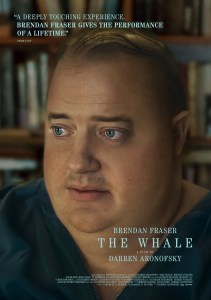
Charlie (Brendan Fraser) is a morbidly obese English teacher facing into the fact that soon he will die as his heart slowly fails from the pressure his obesity has placed on it.
In his final days he seeks to reconnect with his daughter Ellie (Sadie Sink) whilst also trying to be open and honest with his friend and carer Liz (Hong Chau), his ex-wife Mary (Samantha Morton) and a young missionary named Thomas (Ty Simpkins) who knocks on his door in a moment of need. Based on a play the film is essentially a rotating two hander. Charlie ever present in his apartment he can never leave discusses his life and impending death with these other characters.
One of the key lessons that he extols to his students that he speaks to online whilst keeping his camera switched off is that the best writing comes from being authentically honest. Something that so many people struggle to do until they are aware of their impending inevitable demise into nothing. Whilst the film focuses on five characters who despite their love for each other struggle to connect because of the things that have come between them that make it hard to be honest.
Charlie himself keeps the greatest essay that he feels he has ever read nearby. In moments of struggle he reads it or has others read it to him despite the fact that he has it committed to memory. The essay is a review of the book Moby Dick by Herman Melville and speaks of the authors heartfelt reaction to it. It is Charlie’s anchor and it keeps him centred in moments of pain.
From an acting perspective it is Brendan Fraser’s performance that anchors the film. In amongst his fat suit and make up he delivers a heartbreaking and heartfelt character. Oscar nominated for Best Actor in this year’s upcoming ceremony it is hard to see past this massive role. But all four of the other actors also deliver wonderful characters and performances.
As we hear about the events in Charlie’s life that have put him where he is, as we notice the rain outside and witness his memory of when he last swam we connect to him because of his honesty.
The Whale is a film that on its surface seems straightforward. But as I have thought about it and its themes it feels deeper and deeper with each passing day. Its themes include religion, its hypocrisies and the manners in which it gives people meaning. Parenthood and families, both familial and chosen. Honesty and how running from it and delivering it can both cause pain as well as deliverance.
Director Darren Aronofsky is no stranger to these themes so it seems unsurprising that he has gravitated to putting Samuel D. Hunter’s play onto the big screen. Aronofsky has covered religion at length in his films Pi, Noah and mother!, he has covered love and family in The Fountain and the story of estranged daughters and fathers in The Wrestler. And he has done another fantastic job here in a story that has an element of melodrama but pays off superbly. Aronofsky has even added an ending that play-write and screenwriter Hunter has approved of. One that evokes an uplifting and spiritual ending.
 Phil the Bear's Film Reviews
One thought on “The Whale”