
The Planet of the Apes started life as a 1963 novel by the French author Pierre Boulle called La Planete des Singes. This was later adapted into the incredibly successful 1968 film The Planet of the Apes, directed by Franklin J. Schaffner starring Charlton Heston and Roddy McDowell. The success was such that it spawned four sequels between 1970-1973:
- Beneath the Planet of the Apes (1970)
- Escape from the Planet of the Apes (1971)
- Conquest of the Planet of the Apes (1972)
- Battle for the Planet of the Apes (1973)
You can read my thoughts on these here – The Planet of the Apes Original Films Review (1968-1973)
In 2001 Tim Burton released a “reimagining” of the original film starring Mark Wahlberg and Tim Roth.
And then most recently a reboot trilogy was released between 2011-2017. The reboot tells the story of a chimpanzee named Caesar (Andy Serkis) who would lead the first ape civilisation on Earth.
In 2024 we will see the next film in that reboot series. Kingdom of the Planet of the Apes is due for release on May 24th, 2024 and as a refresh I watched the reboot trilogy again and wanted to share my thoughts.
Please note that due to the age of the films and the fact I am going to be discussing them sequentially some major plot points will be spoiled. If you have not already seen this brilliant trilogy and want to go in fresh watch them first.

Rise Of The Planet Of The Apes (2011)
Will Rodman (James Franco) is a scientist working on a cure for Alzheimer’s disease. His breakthrough drug ALZ-112 appears to go beyond its remit of repairing brain function and makes the ape it is being tested on highly intelligent. However when the ape is to be presented to the board she goes crazy and attacks the humans trying to display her. The result is Will’s boss Steven (David Oyelowo) calling for all of the apes in the study to be euthanised and the study be shut down.
Unbeknownst to Will, his star test subject named Bright Eyes had given birth to a baby in captivity. Her outburst and attack was not caused by the drug but by her urge to defend her offspring. Will decides to take the baby home where we meet his father Charles (John Lithgow), a man suffering with Alzheimer’s. Will decides to raise the chimp and illegally test ALZ-112 on his father.
As the years pass Charles not only gets better, but becomes more intelligent. Whilst Caesar, named by Charles after his favourite Shakespeare play, learns sign language and becomes a part of the household.
Rise of the Planet of the Apes has a wonderfully constructed script where everything seems to slot together and flow smoothly from one plot point to the next. The story spans across approximately 9 years as we see Caesar develop and grow. Whilst the plot elements that lead to the rise of the ape civilisation and the detriment to the human one seem perfectly contrived.
Will’s singular drive to push for human trials on ALZ-112 is derived from his love for his father and the man he is losing. So when he later throws caution to the wind based on what he believes is sound scientific evidence and tests the drug on his father we find it believable. The film then takes the time to build up a family unit. Will, Charles and Caesar are joined by Caroline (Freida Pinto), a vet who Caesar helps to get Will a date with. This strange family unit spend outings together at the redwood forest in Muir Woods National Monument, a place that will become important to Caesar.
The time the film takes to build our attachment to this family unit makes the two major setbacks they face more impactful and the reactions to them more believable. When Charles’ immune system builds a resistance to ALZ-112 and it sets Will to work more frantically on a more virulent strain of the virus (ALZ-113) we understand why. And when Caesar attacks someone who he deems to be a threat to the now mentally challenged Charles we understand why. The consequences of both actions will result in the Rise of the Planet of the Apes though and a stand off on the Golden Gate Bridge.
The performances within the film are wonderful, especially those delivered in performance capture. Andy Serkis’ portrayal of Caesar is one that resulted in lots of discussion about motion capture performances being recognised by awards bodies and it really is special. But this film more than the others features some great “human” support. James Franco, John Lithgow, Brian Cox, Tom Felton, Freida Pinto and David Oyelowo do a very good job of giving the full spectrum of good and bad in human behaviour.
The special effects at the time were revolutionary with the motion capture work on the apes outstanding. The manner that director Rupert Wyatt intertwines the human and ape emotional elements whilst using all of the effects work is exceptional. In fact one of the biggest shocks at the release of the sequel was that Wyatt decided to drop out of directing it because he felt there was not enough production time. Perhaps a decision he may have come to regret given his output since then.
For fans of the 1968-1973 films keep your eyes and ears open for an insult about a “damned dirty ape”, an ape named Cornelia, a 3D puzzle of the Statue of Liberty being completed by Caesar, the Hopkins manual dexterity test, Caesar’s mother being named Bright Eyes, hose pipes being used to quell prisoners and a news report about a space mission to Mars that goes missing.
This is a film where a reboot/remake can easily be discussed as being better than the original.
Dawn Of The Planet Of The Apes (2014)
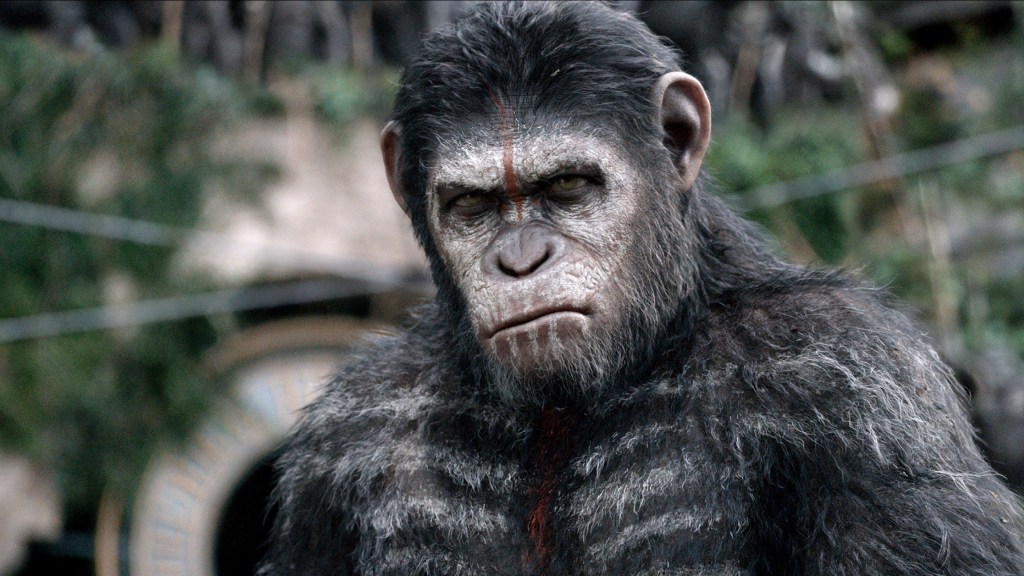
Ten years after the events of ”Rise”, Caesar (Andy Serkis) and his tribe of apes now live in the redwood forest he used to visit with his human family. Caesar’s group has expanded greatly and so too has his family. Wife Cornelia (Judy Greer) has borne him a son named Blue Eyes (Nick Thurston) who has all the spirit of a teenager whilst his inner circle includes the damaged and bitter Koba (Toby Kebbell), the compassionate Maurice (Karin Konoval) and the loyal Rocket (Terry Notary).
All is well until a group of humans make their way into the forest looking to repair the hydroelectric damn as a way to restore power to their colony in San Francisco. They stumble upon some apes and a confrontation ensues where Rocket’s son Ash is shot and injured. Caesar is forced to act and whilst trying to avoid confrontation he marches a force of apes to the human colony and tells them never to enter the forest again.
The human group is led by ex-soldier Dreyfus (Gary Oldman) and Malcolm (Jason Clarke). They are desperate to maintain order and civilisation in their community and fear that without power they will lose control. So despite the setback Malcolm volunteers to try to reason with Caesar and heads back into the forest with his makeshift family unit consisting of Ellie (Keri Russell) and Alexander (Kodi Smit-McPhee).
After “Rise’s” focus on how an ape civilisation began, “Dawn’s” focus is on the divide within both the ape and human colonies shown. Caesar and Koba both want the ape community to flourish and be safe but their approach to humans is fundamentally different because of their experiences with them. Whilst Malcolm and Dreyfus want the same for the human group but again disagree on how to achieve it. The juxtaposition makes for a fascinating watch and underlines the humanity within the apes. Can Malcolm and Caesar foster a trust that can flourish across both communities or will Dreyfus and Koba’s hatred for each other’s species send them into war?
“Dawn” spends much more of its time focusing on the motivations of its characters, their relationships and similarities. The result is a film with a smaller scope than “Rise” but a sharper focus. Andy Serkis is again brilliant as Caesar and gets to deepen his character’s burden given his role as ruler but it is the addition to the cast of Toby Kebbell as Koba (the smaller role of Koba in Rise was played by Christopher Gordon) that creates the biggest spark of the movie. Koba’s hatred of humans and his betrayal of the community is beautifully realised and understandable. And Jason Clarke gives great support as the main “human” role as one of the few who see the humanity in the apes.
The special effects and motion capture work in this sequel take another massive step up from the original film. The facial expressions on the apes is superb at showing their emotions whilst the number of apes on screen in the woods and the rain is phenomenal.
The film also features some fantastic scenes. The opening of “Dawn” starts with a scene that mimics “Rise’s” credit sequence with the addition of news reports that quickly catches us up on the downfall of the human race. The action sequences and the final “ticking clock” race to save the apes at the end are thrilling.
Despite the change of both writer (Mark Bomback taking over from Rick Jaffa and Amanda Silver) and director (Matt Reeves taking over from Rupert Wyatt) this sequel manages to maintain the quality of the original.
War For The Planet Of The Apes (2017)
The final film in the trilogy is the only one that I already have a review of on my site. You can read that here if you want to see my original thoughts… War for the Planet of the Apes
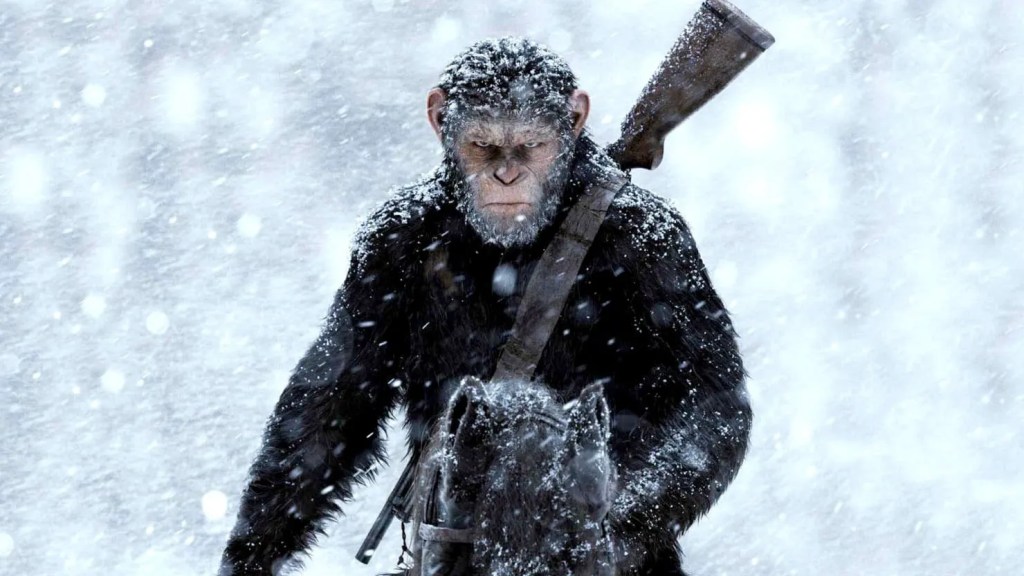
Immediately following the events of Dawn, Caesar (Andy Serkis) and his colony of apes are being hunted by a military group led by a mysterious Colonel (Woody Harrelson).
The war started by Koba rages on and apes loyal to him now fight alongside the humans for fear of retribution from Caesar were they to try and return to the fold.
Rocket (Terry Notary) and Caesar’s son Blue Eyes (Max Lloyd-Jones) have found a way out for the apes though. A sanctuary on the other side of a desert. If they can escape the forest where they are currently locked in constant warfare they could make a new life away from humans. But before they can leave the Colonel leads a devastating attack on the apes home and Caesar must take a difficult decision.
Caesar decides to leave the group on a personal mission to kill the Colonel. Mostly as a mission of revenge and ostensibly as a distraction that will allow the tribe to escape the forest. But Maurice (Karin Konoval), Luca (Michael Adamthwaite) and Rocket decide to go with him and so they set out to track down the Colonel and his army.
The journey is a personal trial for Caesar. He sees Koba in his nightmares and finds himself in a battle for his soul. Was it his failure that resulted in so many apes death? Is he just like Koba?
On their journey the group will pick up a mute girl that they name Nova (Amiah Miller) in a nod to the 1968 film’s character and another ape called Bad Ape (Steve Zahn) who used to live in a zoo.
Whilst the colonel and his army have many nods to Apocalypse Now and 1970’s Beneath the Planet of the Apes. The Colonel can be seen shaving his head, whilst his unit have many slogans and the Alpha and the Omega daubed on their equipment. One slogan even uses the phrase “Ape-pocalypse Now”.
The impacts of ALZ-113 continue to be felt and humans must decide how to approach the fact that the mutating virus is now rendering some of them dumb. Something that answers questions raised in the original movies.
As has been the case throughout the trilogy every plot point and thread comes together to deliver a gripping finale to a wonderful trilogy.
Final Thoughts
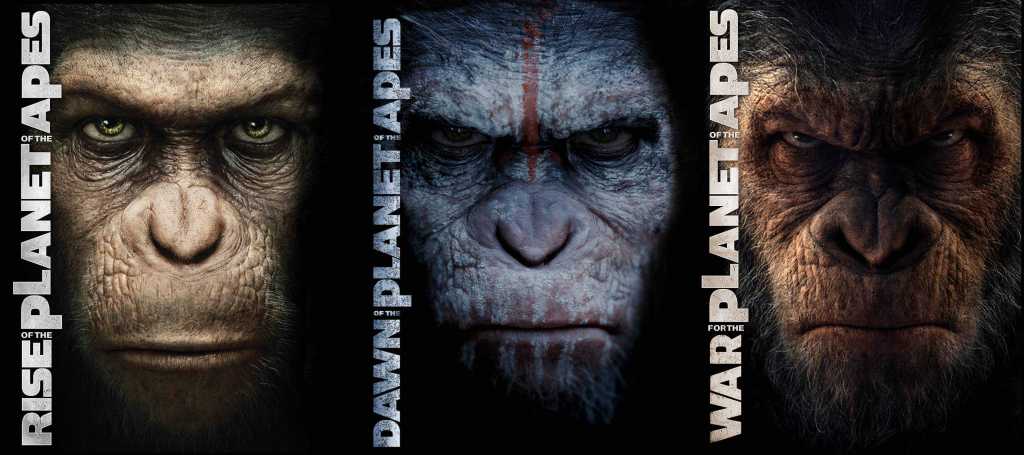
One of the most popular film arguments is about ranking them against each other and I have to say that trying to do so here has been driving me crazy. At various times during the re-watching of these films and the writing of this article I have had every film in top spot.
“Rise” tells a brilliant and cogent story that makes the rise of Caesar and his apes as inevitable as the downfall of the human race. Its focus is on father-son relationships and how the way you are raised shapes you. Whilst Caesar’s evolution from baby to leader is perfect.
“Dawn” expands upon the theme of how you were raised shapes how you behave. The nature versus nurture argument is perfect here given we have a story of humanity and the humanity within a new ape society. Koba’s treatment by humans makes him bitter and filled with hatred. Something mimicked by Dreyfus hatred for the wild animals that he sees in the apes. Whilst Caesar and Malcolm both want to see the good in each other and build trust. The similarities just underlining the humanity in the apes.
“War” then places Caesar in the same position as Koba found himself in, even seeing him in his nightmares. It forces him to struggle with the idea of being a father to his people or face losing his soul in seeking revenge for the pain he has suffered. Whilst the human race continues to bring its own downfall by succumbing to the infighting that Caesar fought against.
As the films progress the role and function of humans becomes less and less in keeping with a new apex civilisation on Earth. “Rise” in the main only featured Caesar amongst a mostly human cast. “Dawn” features a small group of humans whilst “War” only features two significant human roles in the Colonel and Nova.
So which is my favourite? I just cannot decide. They are all so brilliant and I strongly recommend you rewatch this brilliant trilogy before the arrival of Kingdom of the Planet of the Apes.
It is however a lot simpler to say that this trilogy is better than the previous six films in the franchise both singularly and as a collective. Of course they owe them for the inspiration that they have given them but they have surpassed them. My suspicion is that this year’s continuation might go some way further towards perhaps making these films prequels to the 1968-1973 films. Although I truly hope they remain separate.
My final words are to reiterate how amazing the stunning effects work is. And more importantly the ground breaking manner in which it allowed the actors to make unforgettable characters. Andy Serkis’ Caesar would be talked about alongside some of the greatest performances of all time if this was in a drama feature with no special effects.
And remember…
Apes Together Strong
Want more Apes articles?
 Phil the Bear's Film Reviews
I totally agree. This trilogy is awesome and does improve upon the foundations built in the originals
LikeLiked by 1 person