
This year we will see the 10th film in the Planet of the Apes franchise, which will be the 4th film in the current series. This prompted me initially to rewatch the fantastic trilogy made between 2011-2017 and write about it in this article – The Planet of the Apes Trilogy Review (2011-2017)
I enjoyed myself so much through the whole process that I decided to watch all of the films in the franchise and write about them.
So let’s return to the Planet of the Apes. But this time it will be the 1968-1973 series of films…
The Planet of the Apes started life as a 1963 novel by the French author Pierre Boulle called La Planete des singes. The rights of which were bought by Producer Arthur P. Jacobs. Between 1968-1973 his production company APJAC Productions released 5 films amongst other ventures in television and comics. Sadly Arthur died in 1973 at the age of 51 of a heart attack. His widow made the decision to sell all rights to Planet of the Apes to Fox who would go onto create the newer films.
For the 2011-2017 films I was rewatching films I had seen before. Here though I had only ever previously seen the original film. So four of these films were first time watches for me.
Before I dive into my reviews, as with my previous article I want to give a spoiler warning. Due to the age of the films and the fact I am going to be discussing them sequentially some major plot points will be spoiled. This is especially true here as each film follows the last and in some cases the films even feel the need to give a “previously on” intro.

Planet of the Apes (1968)
At the beginning of a galactic journey a group of four astronauts led by George Taylor (Charlton Heston) enter hibernation on their spaceship in 1972. When they awaken their ship has crash landed in a lake on an unknown planet. For them only 1 year has passed but as a result of time dilation the year is now 3978.
Due to a malfunction in her sleep chamber the only female member of the crew has died. So Taylor and his two colleagues Landon (Robert Gunner) and Dodge (Jeff Burton) grab some supplies and abandon ship before it sinks to the bottom of the lake.
After some exploration of the desolate desert near the lake they find a waterfall and decide to go skinny dipping. On completion of their raucous dip they find some primitive humans who are unable to talk have destroyed their clothes and equipment. Taylor muses that if this is the best the planet has to offer that they will be its rulers in six months.
We then see a number of intelligent apes stride in on horses and begin to hunt the humans as though this was sport for them. Dodge is killed, Landon disappears and Taylor is shot in the neck temporarily muting him. Now captured by apes Taylor meets sympathetic scientist chimpanzees Cornelius (Roddy McDowell) and Zira (Kim Hunter) and ruling orangutan Dr. Zaius (Maurice Evans).
Taylor attempts to convince Cornelius and Zira that he is intelligent and that they should help him. Whilst Dr. Zaius sees him as a threat to ape civilisation and believes all humans should be eradicated.
This version of Planet of Apes stirs up a lot of conflicting emotions for me when watching it. A classic movie should be able to stand the test of time and regardless of effects, costumes, sets or techniques aging it the story and artistry should shine through. There are times that this happens and there are times when it simply does not.
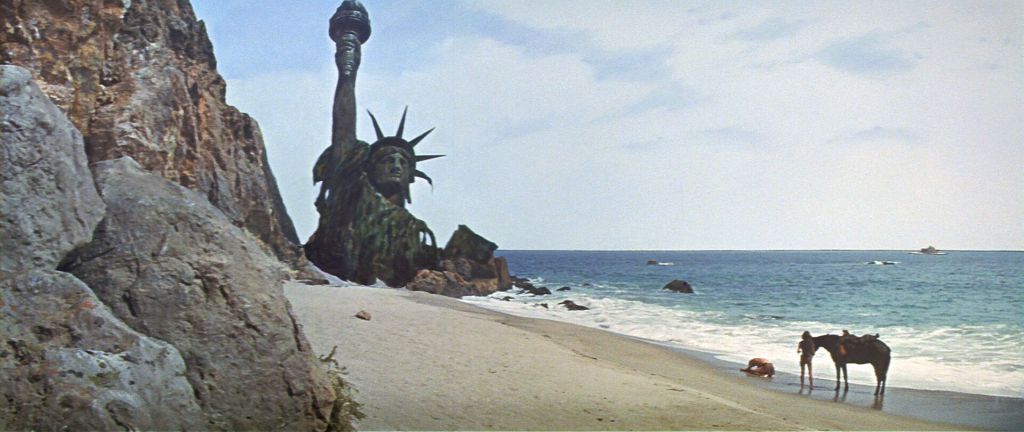
Some of those good moments have now entered the consciousness of the masses in such a way that my children know the famous ending to this film without ever watching it. Or perhaps that is more a statement on the popularity of The Simpsons and the episode entitled “A Fish Called Selma”? I do wonder what it must have felt like to watch this film in a cinema in 1968 and witness it with no prior knowledge.
Charlton Heston also gets to utter two absolutely legendary lines in this film. One is an insult directed at an ape at the midpoint whilst the other is the final line of the movie in the aforementioned scene. If you are somehow still unaware of what I am talking about I strongly suggest you stop reading and go and watch the film.
Otherwise the central conceit of humans seeing a mirror of themselves and seeing their own destructive nature is intriguing. Whilst the behaviour of Dr. Zaius is a perfect microcosm of this. The way he tries to erase all evidence that humans could be intelligent and considers it heresy shows how easily the ape ideology and religion could crumble when challenged.
The ape costumes and masks whilst considered revolutionary at the time have aged to the point that modern audiences should be expected to suspend their disbelief. At the time the film won an honorary Oscar for outstanding make-up achievement and was nominated for best costume design.
The areas that have aged badly are the action sequences and Charlton Heston’s particular style of machismo. The latter of course is an acquired taste but the idea of a man smoking a cigar on a spaceship and at any other opportunity whilst bullying his fellow crew members, salivating over the woman given to him as a “mate” and using a rather over the top acting approach can grate a little. But really it’s the action sequences that call for the biggest level of patience. It is impressive to see humans wearing full face masks ride horses but they clearly impeded vision and movement to the point that both the hunt sequence and Taylor’s escape attempt seem amateurish.
It is still a classic. But not one that sits alongside the greats.
Having recently rewatched the 2011-2017 trilogy it was great fun to spot so many homages that it had made to this film. Taylor is referred to as Bright Eyes, the Hopkins Dexterity Test is mentioned (how the apes would know about this is absolutely in question), the female given to Taylor as a mate is named Nova and a human doll plays an important role.

Beneath the Planet of the Apes (1970)
Brent (James Franciscus) is the only surviving astronaut on a rescue mission sent to look for the astronauts sent into space from the first film. In his search for Taylor (Charlton Heston) and his crew he finds Nova (Linda Harrison) who is in possession of Taylor’s dog tags. She leads him to Ape City where Brent is shocked to see intelligent apes ruling.
Brent and Nova do not get particularly far before finding themselves in trouble but luckily Cornelius (David Watson taking over for Roddy McDowell for this film) and Zira (Kim Hunter) provide assistance.
In the meantime a warmongering gorilla named Ursus (James Gregory) marches a contingent of apes into the Forbidden Zone to conquer it resulting in Brent and Nova hiding in a cave system that leads to the New York Underground. Brent’s realisation that he is on his own planet in the future is slightly more understated than Taylor’s in the first film but still works quite well.
As Brent explores the underground he finds a group of telepathic humans who worship an atomic bomb labelled with the Alpha and Omega symbols. When all three groups collide the results are cataclysmic for the planet of the apes.
Beneath The Planet Of The Apes is incredibly poor. It is hard to really quantify quite how disappointing the whole thing is succinctly but I will try. Charlton Heston’s character features only in the bookends of the film and to say it feels like he is “phoning it in” is an understatement. His replacement, James Franciscus does a reasonable job but his character’s arc is to just keep getting captured and escape. Cornelius, Zira and Dr. Zaius (Maurice Evans) are all mostly sidelined and Roddy McDowell does not even reprise his role. This is the only film of this series of five that he does not feature in. The entire plot line is inane with apes as a whole generally sidelined and the villains of the piece an underground group of telepathic humans who worship a bomb. Perhaps at the time it served as a warning and reflection of the fear of atomic warfare in the Cold War but it has not aged well.
Possibly the most shocking moment for me really was the ending of the film because it felt like it ruled out the possibility of more sequels and I knew I had three more to watch!

Escape from the Planet of the Apes (1971)
A spaceship crash lands in the water resulting in the US army mobilising to greet whomever has arrived on Earth. As the three astronauts step out of the ship and remove their helmets all are shocked to see chimpanzees who seem intelligent. Moving them from the crash site to an army base and finally a zoo they send in two scientists to examine them.
Escape from the Planet of the Apes has to do a lot of heavy lifting to make its story make sense and having watched the films in such close proximity it fails miserably. We have to believe that Cornelius (Roddy McDowell returning), Zira (Kim Hunter) and new to the series Dr. Milo (Sal Mineo) were able to pull Taylor’s ship out from the lake into which it crashed in the first film, move it to a new location, repair it, learn how to use it and launch it before the planet exploded at the end of the second film. Given that we last saw them aiding Brent in the second movie very shortly before those events happened it is a stretch to say the least! But luckily we have the before unheard of Dr. Milo as the cause of all these things.
What the plot should have allowed for though was a story that examined the reverse of the original film. What would humans do if advanced chimpanzees landed on Earth? The answer apparently is treat them like they are part of a 1970’s comedy sitcom. The tonal change from the first two films to the first half of this one is whiplash inducing. We have a string of comedy sideshows where our characters go shopping for clothes, do interviews, have parties and get put up in a posh hotel. This is all after Zira nails all of her tests and makes one of the scientists faint when she talks.
The tone then flips entirely again as one of the humans decides that these apes will be the downfall of humanity as he joins the dots that their civilisation is our future. And we change from comedy sitcom to murderous extermination… including Zira’s unborn child. Cornelius even helps outline how apes become the dominant species, something no one seemed to know in the first two films.
The one thing that is consistent across these first three films is that each ending is as bleak as the next. Whether it is humans or apes our appetite for destruction knows no bounds.
Ultimately this sequel feels like the weakest of the series. Its plot struggles to write its way out of the corner the second film put it in and it fails to warrant its existence, whilst also feeling like a cost cutting exercise by only needing three chimpanzee costumes for its duration. Add to that its bizarre swing in tone from knockabout comedy to doom mongering and it is a mess.

Conquest of the Planet of the Apes (1972)
North America 1991. Twenty years on from the previous film and Armando (Ricardo Montalban) has kept Caesar (Roddy McDowell) hidden from the authorities since his Mother Zira swapped him with another chimp baby at his circus before the final moments of the previous film.
Cornelius’ prophetic stories of a dog and cat plague have come to pass and apes have moved from being pets to slaves for the human race. (This of course has happened on a much faster timeline in order to keep Caesar part of the story).
Human society appears to have become far more totalitarian with police wearing all black fascistic outfits and the government holding an iron grasp over its people and the ape slaves they use to service it.
The plot sees Armando taken for questioning and brutally tortured whilst Caesar is sold into slavery in a high security wing of the government. Whilst Caesar tries to hide his ability to talk it does see him unify and mobilise the apes in an uprising. Having spent years watching apes badly treated by humans he can stand no more and uses his knowledge gained in servitude to help with his uprising.
If you excuse another glaring retcon from the previous film where the cat/dog plague and ape uprising took two centuries rather than two decades the plot here makes reasonable sense in the grand scheme of things. The main issue is the way that everything is shot in a slapdash amateurish fashion. Churning out sequels at such speed and with lower budgets has an impact and here it is felt in any scene that has a crowd in it. The start of which is the frankly insane “ape conditioning” scenes where we see apes being offered bananas whilst guards fire flame throwers at them or ask them to pour glasses of water whilst disco lights are pointed at them. To say it is comical is an understatement. There is a torture scene where a guard just swivels dials on a machine seemingly at random whilst the big ape uprising and escape could probably be staged better by any large drama school. The direction to the extras in ape costumes seems to have been “just jump about and fall over”. Whilst later we see groups of apes just charge straight at flanks of soldiers with guns. The length of time we get to watch apes shuffle like zombies towards walls of fire and a line of bullets is bizarre in a film with a very short running time (88 minutes).
Caesar’s grand speech at the end does feel like a landmark for the series direction though and with a bigger budget and longer schedule this film actually feels like it could have matched the first. Unfortunately though its flaws are difficult to see past.

Battle for the Planet of the Apes (1973)
North America 2670. An orangutang Lawgiver (John Huston) is about to tell us the story of Caesar (Roddy McDowell) and how he created ape civilisation. We are given a handy recap of the previous two films before heading back in time to approximately 10-15 years after the events of the last film.
Caesar, now with his own young son Cornelius (Bobby Porter) is a leader of a burgeoning civilisation where humans are living under ape rule. Whilst Caesar wants apes and humans to live alongside each other the gorilla Aldo (Claude Akins) wants to eradicate them all. Searching for an answer to this conundrum Caesar is told by MacDonald (Austin Stoker) that there is archive footage of his parents in the Forbidden City (the setting of the uprising in the previous film) and perhaps his answer is there.
Caesar and MacDonald’s trip only manages to cause two issues though. Firstly it allows Aldo to increase his power by sowing more discontent about Caesar’s leadership. Secondly it inspires the radiation damaged humans living in the Forbidden City to set out after Caesar and attack his settlement.
Battle for the Planet of the Apes has a few intriguing ideas in it. The wraparound sections with the Lawgiver are set approximately one-thousand-years before the original film and seem to suggest that there was a period of harmony established by Caesar at least for a brief time. Whilst the idea of the Forbidden City and the radiation damaged humans is an intriguing way of setting up those facets of the first and second film. The ape civil war was also clearly an inspiration for Caesar and Koba’s relationship in the 2011-2017 films.
The issues though are similar to the previous films. With a smaller budget and a production schedule turned round in rapid speed this film is as amateurish as the previous one. The section where the humans “assault” the ape settlement is like a reject Dad’s Army version of Mad Max. The humans’ radiation injuries consist of a bit of latex on their faces. The fight sequences are terrible, although they do bring back the Planet of the Apes obsession with nets. And ultimately the story is paper thin and hinges on the idea that an ape can die falling out of a tree that looks about 6 feet up.
Despite all of these drawbacks I still found myself enjoying it more than the other sequels. Or perhaps that was because I knew the saga was ending?
Final Thoughts
One of the biggest impacts on the quality of this series is the budget and time between films. As you can see from the below statistics the budgets slowly got less and less whilst they attempted to churn out a blockbuster movie each year.
- Planet of the Apes – 112 minutes – $5.8 Million – 1968
- Beneath the Planet of the Apes – 95 minutes – $2.5 Million – 1970
- Escape from the Planet of the Apes – 98 minutes – $2 Million – 1971
- Conquest of the Planet of the Apes – 88 minutes – $1.7 Million – 1972
- Battle for the Planet of the Apes – 93 minutes – $1.7 Million – 1973
Consider the time taken between sequels in this day and age along with the stratospheric budgets and you know full well that the plotlines, effects and polish will all suffer. As I was watching the films it struck me how they look both incredibly realistic and incredibly cheap at the same time. Shot on real locations with real backdrops everything just looks completely ordinary. But as soon as you encounter anything that is supposed to look futuristic or requires large amounts of people or coordination everything becomes incredibly amateurish. The dwindling budgets and annual turnaround start to really show by films four and five where “bustling” civilisations are just a group of people sitting around a bad set or in a wood.
I was also taken aback by the running times of the films. Again this feels like a side effect of the short turnaround time and budget but it did allow me to watch the final three movies on the same day. The plot lines for films 3-5 are very light on detail and sometimes struggle to fill their short running times. One thing they do consistently deliver are incredibly bleak endings given their blockbuster nature.
Despite the disappointment of the sequels the original is still a landmark movie with an iconic ending. The make up and costumes started to wear thin by the end of the films but are still fairly impressive in the original. Whilst I was always impressed with the horseback riding whilst wearing the full costumes and masks.
I think watching the 2011-2017 series before this series helped immensely in spotting all of the homages but ultimately made the shortcomings found here much more noticeable.
Want more Apes articles?
 Phil the Bear's Film Reviews
6 thoughts on “The Planet of the Apes Original Films Review (1968-1973)”