
Every ten years the revered cinephile magazine Sight & Sound conducts a poll asking the most influential film critics, academics, writers, archivists, curators and programmers what their top ten greatest films of all time are. In 2022 the poll was conducted again with more than 1,600 people asked to submit their greatest films.
The result this time was fairly controversial with the Number 1 spot taken by a film that few people outside of those lofty film professionals circle would have heard of. Personally nor had I and it prompted me to take a look at how many in the list I had actually seen. The answer is a fairly woeful 35 out of 100.
So why not take the top 10 films as a starting point and see what they are made of? Whilst I have seen 6 of the top 10 before I thought there would be no better place than with the greatest of the greatest. So I set about watching them all and writing down my thoughts.
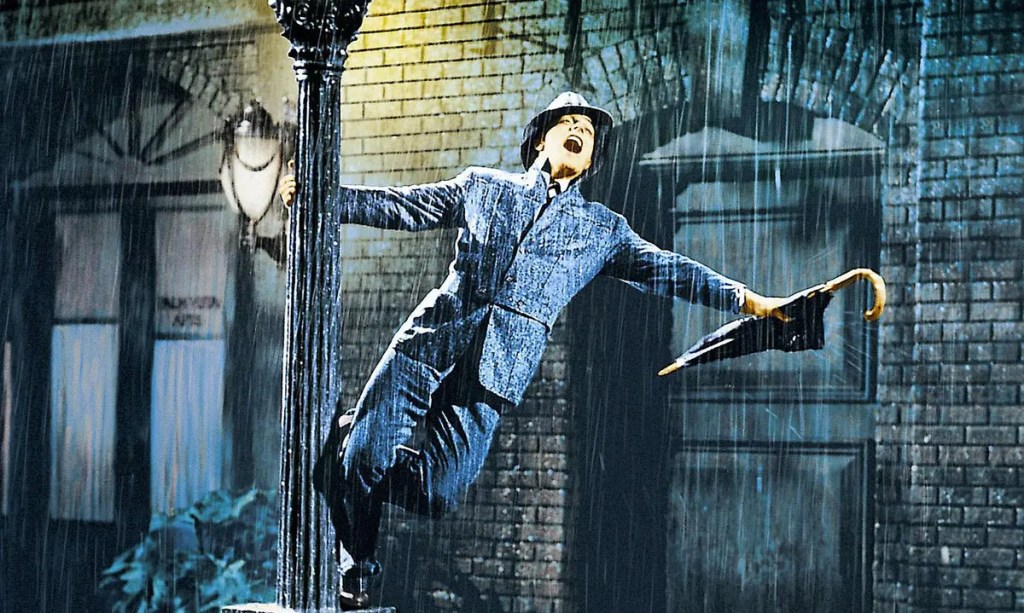
10. Singin’ In The Rain (1951)
Don Lockwood (Gene Kelly) and Lina Lamont (Jean Hagen) are the biggest Hollywood stars of the silver screen with gossip columns adamant they are also the biggest Hollywood couple. There are just a few issues behind the scenes though. Don cannot stand the sight of Lina and more importantly, with the advent of talking pictures Lina’s coarse voice is an issue her stardom may not be able to overcome.
Opening at their 1927 film premiere Don answers some questions in a comedically exaggerated way that explains his rise from musician to stuntman to actor. The flashbacks set up both the comedic and musical elements of the picture as well as giving us the perfect backdrop for Don and Lina’s power couple status and position in Hollywood. Matters are further complicated when Don meets chorus girl Kathy Selden (Debbie Reynolds) whom he falls head over heels in love with. Whilst the mic drop moment of hearing Lina’s voice for the first time is expertly delayed so that it creates the biggest laugh.
What follows is a whirlwind tour of wonderful musical moments, fantastic comedy and good old fashioned Hollywood glitz. Singin’ In The Rain is a wondrous film and its biggest surprise to me is that it manages to cram so much into a running time of 103 minutes.
The top musical moments include Good Morning, Singin in the Rain, Make em Laugh and Gotta Dance. They all feature amazing choreography with Gene Kelly showing off his phenomenal skills with Kelly receiving a Co-Director credit on the picture for the musical numbers.
Singin’ In The Rain has everything. Romance, comedy, music, dance and a reverential nod to the story of Hollywood.
First time watch – No. I have seen this one quite a few times but never on the big screen.
Would I recommend it to the average film fan – Yes. This is probably the most accessible film on this list!
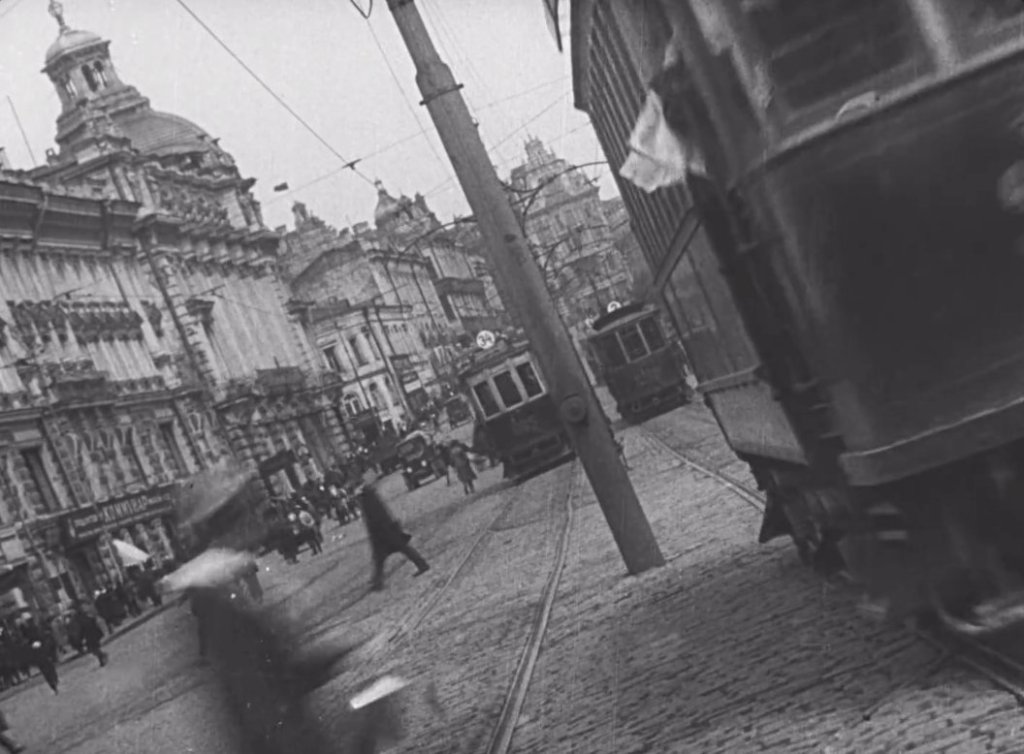
9. Man With A Movie Camera (1929)
Man With A Movie Camera is not a film with a story. Nor is it a documentary. It is an artistic experiment.
The film was shot over a three year period in the cities of Moscow, Kyiv, Kharkiv and Odessa and it simply captures footage of people conducting their lives. You see people at work and at home, getting married and divorced, grieving death and giving birth, riding horses, running and swimming, relaxing at the beach and travelling to work. The list goes on, but you get the idea. It follows no set person and there are no characters. The only recurring character in fact is the man with a movie camera but they have no story, it is simply an idea that it is this person capturing the images. The entire film contains three credits – the director Dziga Vertov, his brother who shot the movie and appears as the titular character Mikhail Kaufman and his wife Yelizaveta Svilova who edited the film.
The film even opens with the following title cards to explain its purpose:
“The film Man with a Movie Camera represents AN EXPERIMENTATION OF THE CINEMATIC COMMUNICATION Of visual phenomena. WITHOUT THE USE OF INTERTITLES (a film without intertitles) WITHOUT THE HELP OF A SCENARIO (a film without a scenario) WITHOUT THE HELP OF THEATRE (a film without actors, without sets etc.) This new experimentation work by Kino-Eye is directed towards the creation of an authentically international absolute language of cinema on the basis of its complete separation from the language of theatre and literature.”
Clocking in at 68 minutes in length it is essentially a film purely for film making purists because ultimately the only educational and interesting facet of the entire project is the fact that it pushed the boundaries of the way a camera can be used to portray events and meaning. The film includes the usage of multiple techniques that the director either invented entirely or developed further. These include slow and fast motion, jump and match cuts, freeze frames, extreme close ups, split screens and tracking shots. Again the list here goes on. Bear in mind that in 1929 some of the shots in this film would have been ground breaking. So when we see two people clearing a chess board in reverse so that all the pieces arrive at their starting positions it would have been a big deal.
Does that mean I enjoyed it? Absolutely not. I understand both its educational and influential importance as a big step in the artistic medium of film. But even at 68 minutes this is not something I would recommend to anyone that was not intent on beginning a career in film making.
First time watch – Yes
Would I recommend it to the average film fan – No. I struggled to get through this and unless you are a budding camera operator or cinematographer this might not hold much entertainment for you.
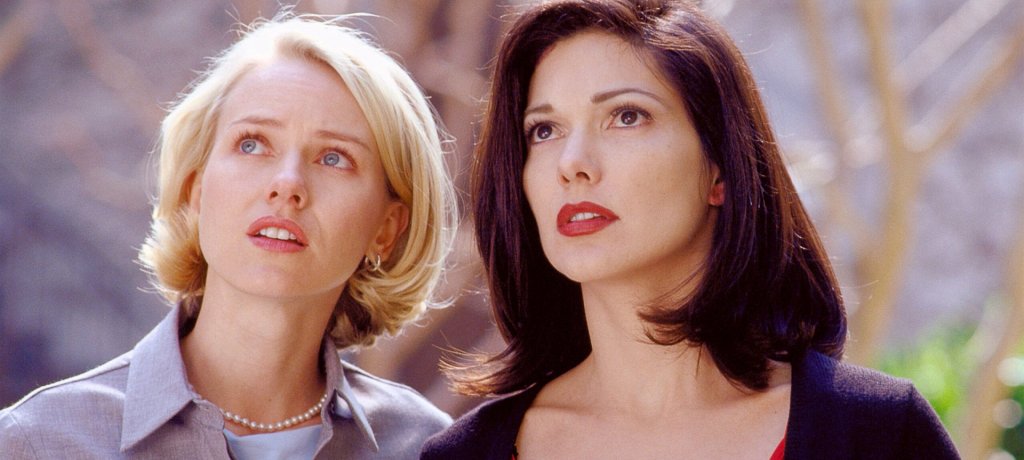
8. Mulholland Dr. (2001)
Glamorous Hollywood actress Rita (Laura Harring) is in an awful car accident that leaves her injured and suffering from amnesia. Fleeing the scene she holes up in an unoccupied apartment.
A young naïve ingenue named Betty (Naomi Watts) arrives in Hollywood and makes her way to her aunt’s unoccupied apartment where she will stay as she tries to make it as an actress.
But of course this is the same apartment and the two will strike up a friendship where Betty will try to help Rita figure out the mystery of who she is and what has happened to her. All the while Betty will attempt to make a name for herself and become a star. The mystery will involve a large sum of stolen money, a dead girl, gangsters running a movie, an amnesiac femme fatale and a dangerous and possibly doomed love story.
All of which sounds like a cliché of a Hollywood film noir which is precisely the point.
It is incredibly hard to talk about Mulholland Drive, or in fact any David Lynch film without massive spoilers. Lynch, who is probably most famous for Twin Peaks does not make normal narrative movies and what you think you are seeing is never usually literally what he is trying to say. Mulholland Drive is no exception and whilst it may be one of the most accessible Lynch films (this is all relative of course) it will take you on a merry ride for approximately 2 hours before in its final 30 minutes it dares to give you some semblance of understanding of what just happened.
At the time its stars were mostly unknown with the likes of Naomi Watts and Justin Theroux now being its most famous cast members and it was originally intended to be a pilot for a TV series which was rejected resulting in it being turned into a film.
It features unforgettable characters and moments such as The Cowboy, the man behind the diner and the Silencio Club. It has a haunting score from Angelo Badalamenti and its labyrinthine plot will never be fully understood in my head.
The result though is something truly impressive and satisfying.
First time watch – No. I have seen this multiple times including on the big screen when it was originally released.
Would I recommend it to the average film fan – Yes, with the caveat that a David Lynch film is something that you will probably never fully understand and you have to let play out to the end. This is especially important here with its revelations coming in the final 30 minutes of its run time.
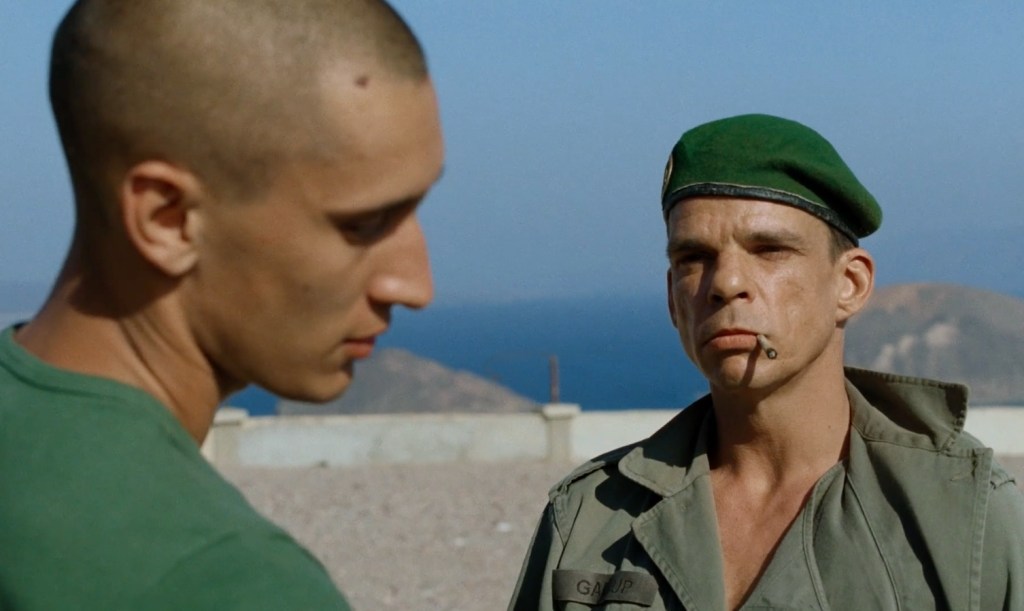
7. Beau Travail (1999)
Sergeant Galoup (Denis Lavant) recalls his time as a legionnaire whilst in Djibouti, East Africa. He considers himself unfit for civilian life and a perfect legionnaire.
Beau Travail translates to Good Work and that is exactly what the film shows us repeatedly. We see the men of the foreign legion training, ironing their clothes, painting, building fences, stretching and any number of other things. The emphasis is on slow, methodical routine. Galoup considers the routine and his time there the best of his life. He respected and loved his commanding officer Forestier (Michel Subor) and commanded his men well. But when a new recruit named Sentain (Gregoire Colin) arrives Galoup takes a disliking to him. When Sentain heroically rescues a man from a helicopter crash, Galoup’s irrational dislike builds to the point that he decides he must act.
Stylistically Beau Travail is sparse. It is shot in a hard, desolate and barren environment with desert as a backdrop. It features virtually no score with the sounds of the men conducting their work or singing whilst they perform their tasks the key soundtrack. It also features very little character dialogue with Galoup’s voiceover of his journal the primary means to understanding what is happening. Whilst its ordering of scenes suggests a lack of respect for a rigid chronological order, as Galoup’s memory jumps from event to event so do the images.
The plot is based loosely on Herman Melville’s unfinished novel “Billy Budd, Sailor” about a senior officer who is jealous of a junior officer and places him subject to a court martial. The novel’s final meaning apparently as nebulous as those explored in this film. Although Melville had the excuse that he died before completing his novel.
Running at only 92 minutes long it feels like it is perhaps double that time. The film is ponderous and slow. The enmity that Galoup shows for Sentain is never truly explained and Sentain himself never seems to react to or do anything to justify this ire. There is a homo-eroticism to a number of scenes where we see half naked men wrestling or them all laying on the floor and stretching in unison so perhaps the feelings that Sentain provokes in Galoup are homosexual desires that he has suppressed deep down and is ashamed of.
However after this slew of meandering images and narration that loosely coalesce into some semblance of a story it features the kind of mic drop ending that truly startles and sticks in your mind. Having only seen one other film by co-writer and director Claire Denis this seems to be a pattern for her as that film – High Life – follows very much the same pattern. Slow, ponderous, difficult to watch, a strong central performance and then an unforgettable and thought provoking finale.
First time watch – Yes
Would I recommend it to the average film fan – No. Despite the ending I found this too ponderous to recommend.
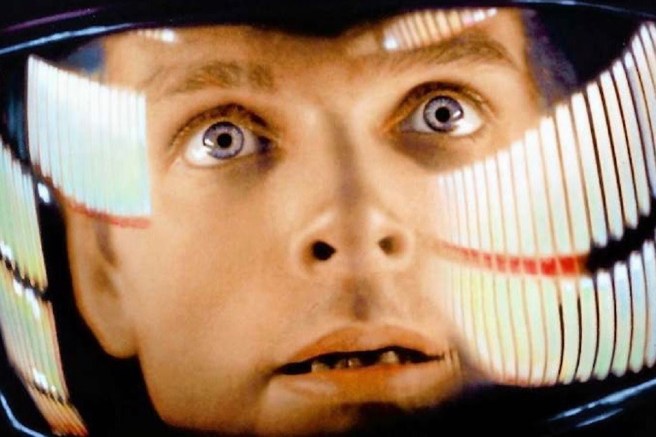
6. 2001: A Space Odyssey (1968)
This is the first film on this list that I have already reviewed on this site and you can find that original review here – 2001: A Space Odyssey Otherwise I have taken elements of the review and placed them below.
The story consists of four main segments. The dawn of man shows us how our ape forebears discover a monolith that bestows knowledge on them that leads them to create tools. We then jump forward a few billion years to see man discovering a second monolith on the moon. We then jump forward eighteen months to a mission to Jupiter. And finally we witness a journey on the discovery of a third monolith. This is the most simplistic break down of a story that even after multiple viewings I would struggle to explain fully.
The sheer confidence and brilliance on display throughout the film is awe inspiring. The feature starts with a minute of darkness whilst music builds to a crescendo and then displays the title card as the bombastic ‘Also sprach Zarathustra’ plays. The dawn of man sequence that follows features no dialogue and the first time anyone speaks is 25 minutes into the film. In fact, the final 23 minutes of the film features no dialogue and in total more than half the film (88 minutes) features no one speaking. The dawn of man sequence also culminates with one of the most famous cuts in cinema, as an ape throws a bone into the air, the camera follows it as it spins upward and then cuts to a space ship in flight.
All of this in the opening 25 minutes. No one could make a film like this now and expect to get wide theatrical release. The closest we’ve had in recent times is Christopher Nolan’s fantastic Interstellar. A film that owes much to Kubrick.
Another thing worth constantly remembering when watching the film is that it was made in 1968. Before man landed on the moon and before digital effects became common in films. It has less effects shots in it than any Star Wars film and utilised rotating sets to get the mind boggling images of people walking around space stations. The effects on show still hold up 50 years on and no credence should be given to moon landing conspiracy theorists, because if Kubrick had filmed them they would have looked a darn sight better than they did!
Given the lack of dialogue, it is the sound and sound effects that really resonate throughout. There are scenes that are completely silent (no space scene features sound due to the vacuum of space), scenes where we can only hear the astronauts breathing building our claustrophobia and scenes with classical music showing the majesty of space. And of course we have HAL’s (each letter the preceding letter in the alphabet to IBM) hypnotic voice. Douglas Rain giving the super computer an unmistakable lilt as he talks to Dave (Keir Dullea) and sings Daisy.
Whilst all of the technical aspects of the film are spectacular, the story and themes are also incredibly thought provoking. The idea that some other intelligence is leading our evolution and providing us with a map to them (Prometheus), that tools/weapons are the basis of our moving forward, but that those tools may try to conquer us (Terminator, Ex Machina) and that space travel might take us to our beginning and evolutionary advancement. So many film makers have taken themes or imagery or both from this film and utilised them in their own, it’s important to see their inception.
Anyone with even a passing interest in film or sci-fi has to watch this masterpiece. Especially when there is an opportunity to watch it at the cinema.
2001: A Space Odyssey is spectacular in its every intricate detail.
First time watch – No. This is probably the film on this list I have seen the most including twice on the big screen.
Would I recommend it to the average film fan – Yes. Although I am probably being too bold in this assertion as it may be too cerebral compared to an average science fiction film.
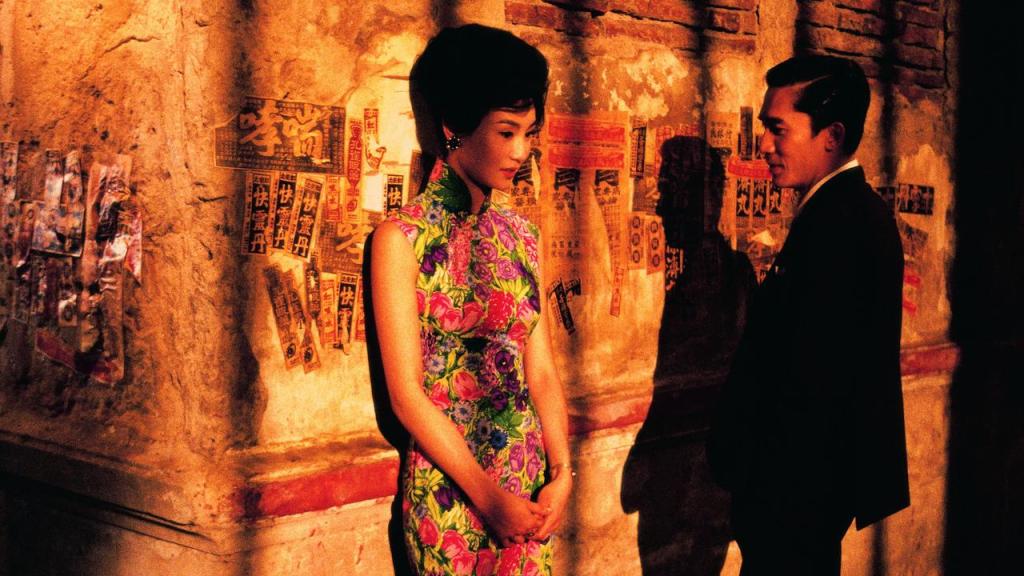
5. In The Mood For Love (2000)
Hong Kong, 1962. Two couples move into neighbouring apartments on the same day. With their partners often away they begin to spend time together, enjoying each other’s company and the things they have in common. One such thing being that they realise their partners are having an affair. Vowing to not be like them, they promise not to have an affair of their own.
In The Mood For Love feels almost like a hazy dream. It looks beautiful throughout with vivid colours amongst the pouring rain the characters often find themselves caught in. Whilst our lead protagonists seem like lonely enigmatic types whose lives you would not want to lead but on screen seem almost magical. Chow Mo-wan (Tony Leung) is a journalist who dreams of writing comic serials, smokes an excessive amount and looks dapper in his suit with slicked back hair. Su Li-zhen (Maggie Cheung) is a secretary managing her bosses affair whilst her husband is constantly on business trips. Again she looks styled to perfection, always in a beautiful cheongsam dress and with perfect hair.
The story is slight and the chemistry considerable. We never see the offending partners. The story laser focused on our protagonists and the connection they have found with each other. There are longing looks among the slow burn story and cigarette smoke lingering in the air.
Writer/director Wong Kar-Wai seems to have captured lightning in a bottle with this feature. It captures a mood of missed opportunity and bad timing. Whilst Tony Leung and Maggie Cheung give memorable and beautiful nuanced performances with their eyes and movements as much as the words they say.
There may be an overarching theme of longing and loss but this film is a real joy to watch.
First time watch – No. But this was only my second viewing and my first since its original release.
Would I recommend it to the average film fan – Yes. This is a real gem and alongside last year’s Past Lives which has similar themes this could be a wonderful double bill.
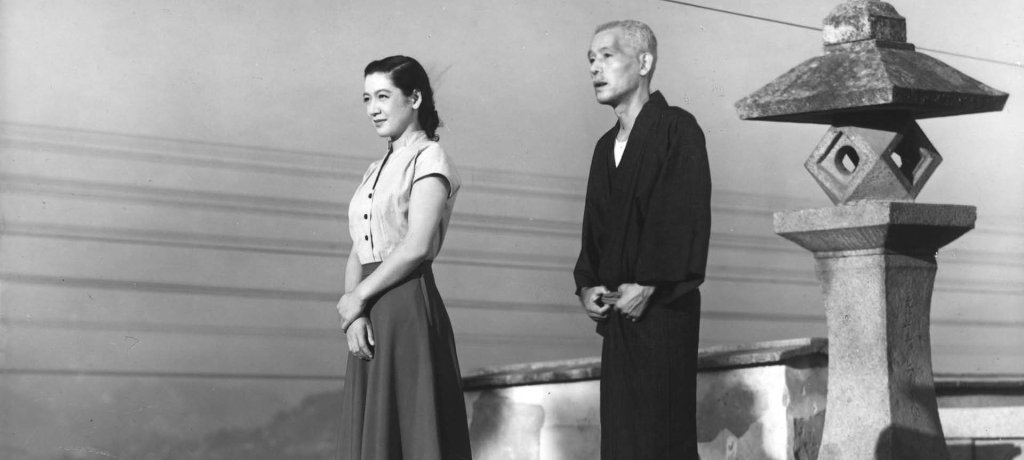
4. Tokyo Story (1953)
An old couple visit their now grown children and grandchildren in Tokyo in post war Japan. Whilst there they are given very little attention and largely ignored by their own offspring whilst their widowed daughter-in-law is delighted to see them.
Tokyo Story is a slice of life drama that plays out in a rather stately manner at 136 minutes long. Very little actually happens and yet it is emotionally compelling. The main focus is the relationship between the couple played by Chishu Ryu and Chieko Higashiyama and their characters’ relationship with their children.
It is hard to explain exactly why it stays watchable other than it feels incredibly insightful and realistic. But it is also a film that I know by today’s standards will be a tough and sometimes slow watch for many. Black and white, subtitled, little to no score and with little plot. It is simply a quite moving account of familial relationships and features a rather sad ending.
First time watch – Yes
Would I recommend it to the average film fan – Yes. My thoughts though are that this film would skew to an older audience, especially those who have or have experienced having elderly parents or whom are elderly parents. I sense that teenagers may not yet quite understand the dynamics on display.
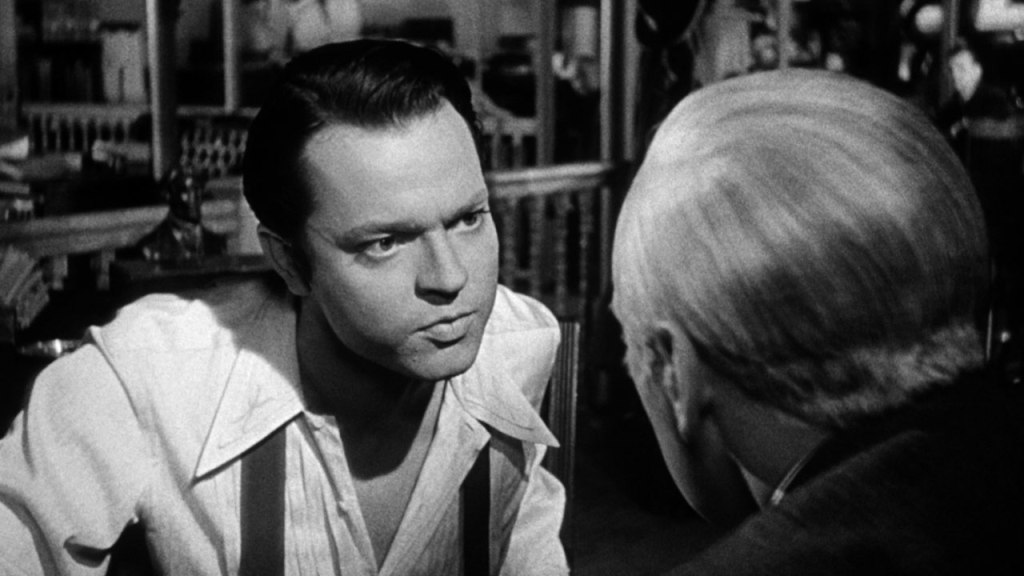
3. Citizen Kane (1941)
Opening with the death of Charles Foster Kane (Orson Welles) as he utters his final words, “Rosebud”, Citizen Kane takes us on an engrossing deep dive into the life of the richest man in the world as told by those who knew him best.
There is so much to say about Citizen Kane but the thing I think is most important is that this is a phenomenal and hugely entertaining film. Something that I often find when this film finds its way into conversation is that people assume that because of it holding the title of “greatest movie ever made” for so many years (it took the top spot in this poll between 1962-2012) there is an assumption that it is going to be a dull, cinephile’s dream that is art over entertainment. That I fear is true of some of the films on this list but certainly not Citizen Kane.
The plot structure is wonderful, constantly keeping you wondering who Kane was. Even if you have had the meaning of Rosebud spoiled by The Simpsons or some other pop culture reference the hook is actually the man, not just his final words. Opening with a foreboding entrance into Kane’s home of Xanadu before an obituary by way of a news reel we get the broad strokes. Then we follow a journalist as he speaks to Kane’s business partner, best friend and ex-wife to try and understand him. All the while learning more and forming our own opinion of Kane.
Everything about the film is groundbreaking and innovative. Made in 1941 it features many cinematic camera techniques that inspired film as we know it now. Cinematographer Gregg Toland uses deep focus to keep everything in shot in focus at the same time, screen wipes that allows one image to dissolve into another and intriguing camera angles that give different perspectives on the action. The make up allows actors to play characters over many years of their lives whilst the flashback structure by way of multiple storytellers mean those flashbacks overlap never giving us a linear view of what happened and telling us from different perspectives which may or may not be reliable. This leads us to Robert Wise’s editing that brings all of the above together in an understandable and snappy manner. Whilst the score from Bernard Hermann and the acting from co-stars Joseph Cotton and Dorothy Comingore is probably easy to place as the best they have ever done.
Orson Welles himself of course was only 26 at the time of the film’s release. It was his debut feature in which he co-wrote (with Herman J. Mankiewicz), starred and directed. It is a phenomenal achievement. And there is plenty of controversy over the film as well. See David Fincher’s Mank for a viewpoint on how much Welles actually had to do with writing the film before delving into the fact that the very film that should have kickstarted Welles’ cinematic career also destroyed it. With Kane loosely based on news baron William Randolph Hearst who banned any mention of it across his news empire, he had made some very powerful enemies. No such issue for the creators of Succession in the 21st Century.
Still a fascinating and engrossing watch nearly 100 years since its release whilst being one of the most influential and controversial films of all time.
First time watch – No. Whilst I have seen this one many times I do not think I have had the pleasure of seeing it on the big screen.
Would I recommend it to the average film fan – Yes! This is the greatest film of all time after all!
2. Vertigo (1958)
This is the second film on this list that I have already reviewed on this site and you can find that review here – Vertigo (1958). Again though, I will place the content below…
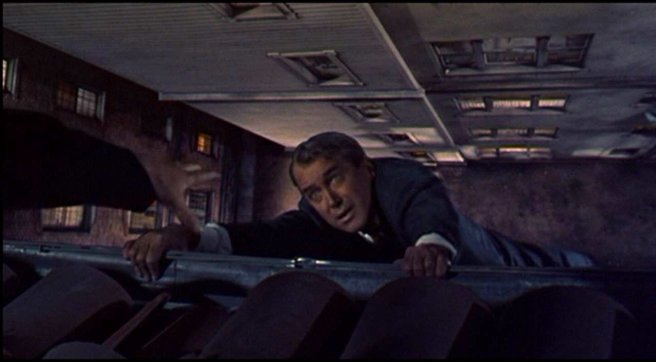
Detective John ‘Scottie’ Ferguson (James Stewart) is forced to retire from the San Francisco police department when the ill timed discovery that he has a crippling fear of heights results in the death of a fellow officer. At a loose end he begrudgingly takes on a private investigation case from Gavin Elster (Tom Helmore) to follow his wife Madeleine (Kim Novak). Gavin is concerned that Madeleine is a danger to herself and wants Scottie to establish what it is she is doing with her time when she disappears during the day. Scottie becomes dangerously obsessed with Madeleine and the need to understand what troubles her.
Vertigo is arguably Alfred Hitchcock’s greatest film and one of the greatest films of all time. I have seen it many times and this latest viewing was to refresh my memory to discuss on a podcast and I found myself endlessly fascinated again by its brilliance.
It has an intricate plot that is so perfect that on every viewing you find yourself spotting a new facet and it feels completely satisfying when it plays out to fruition. Great detective stories on screen are always ones where you feel like everything was right in front of you from the start and just like the protagonist you are so close to understanding everything you just need that final piece of the puzzle.
It is not just the brilliance of the underlying mystery that keep you coming back though. The characters are endlessly fascinating and impressive as well. James Stewart’s Scottie is a character study in obsession and Stewart gives an intense performance that to some extent is against type for him. It is also probably his greatest performance and role which is saying something for a man who was also in Rear Window and It’s A Wonderful Life. Kim Novak is equally brilliant as the mysterious Madeleine and plays a quintessential Hitchcock leading lady. There is also an unsung hero in Barbara Bel Geddes’ character Midge. She is Scottie’s friend whom she clearly has an unrequited love for and a somewhat similar obsession. She is the voice of reason who shows an equally unhealthy focus on Scottie as he does on Madeleine.
The film also features Spirograph like opening credits and a truly distinctive dream sequence from the mind of Saul Bass. There are beautiful painted backdrops in some sequences in a film that looks sumptuous throughout.
First time watch – No
Would I recommend it to the average film fan – Yes. After Singin’ In The Rain this is the next most accessible film on this list made by the great entertainer Alfred Hitchcock.
1. Jeanne Dielman 23, quai du Commerce, 1080 Bruxelles (1975)
Across the course of three days we watch Jeanne Dielman (Delphine Seyrig) go about her daily chores, turn a trick to earn money and look after her teenage son.
Written and directed by Chantal Akerman, who would have been twenty-five at the time the film was released Jeanne Dielman is singularly focused on the life of a middle aged widow whose existence seems to revolve around the daily routine of making meals for her teenage son, cleaning her home and earning money via prostituting herself to regular customers.
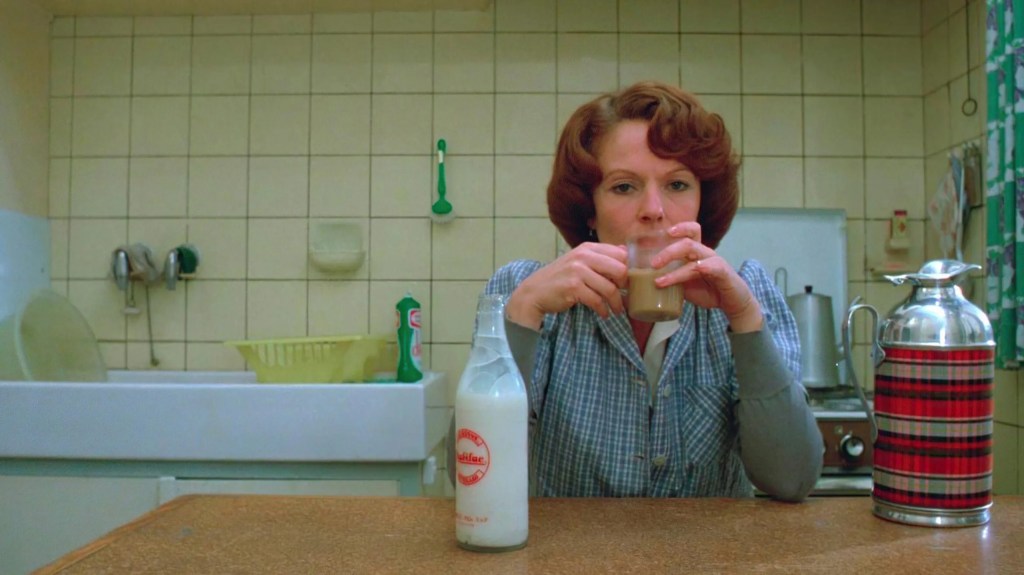
The entire film is an exercise in detail. There is no score, only the sound of whatever household activity Jeanne is currently conducting. Every shot of the film is from the view of a fixed camera. There are no camera moves of any sort, nor are there any close ups or long shots. The entire film is a medium fixed shot of whatever location Jeanne happens to be in. Every take in the film is long and shot in real time. We see Jeanne peeling potatoes, cooking meals, washing in the bath and subsequently cleaning it. Whatever activity we see is uncut and in full. The result is an understanding of Jeanne’s daily routine in absolute intricate detail such that when we see the slightest change or mistake in the routine it is noticeable.
Jeanne spends the majority of her time alone, which means that with no score we are left to watch her cook and clean in relative silence apart from the occasional click of a gas stove or clash of a pan. The one thing that we do not see until the third and final day is her having sex with her customer. In fact so little do we see anyone talking to her that we would not even be aware of her name or circumstances were it not for her reading a letter from her sister out loud to her son on the evening of the first day.
I suspect that the result will either be utterly mind-numbingly monotonous and dull or somehow hypnotising depending on your viewpoint. With a running time of 202 minutes I found my watch of this “greatest film of all time” to be an ordeal that I never want to repeat.
This film is long. Day One finishes at the 47 minute mark. The first time anything happens that warrants a subtitle is 16 minutes into the film. Day two finishes at the 127 minute mark. Day three ends with a nearly six minute shot of Jeanne sitting at a table contemplating what has happened in the final scenes of the movie. No one to speak to, she silently sits in a fixed medium shot as the noise of traffic goes by. And we have to contemplate what it all means.
There are moments when I felt it shared some DNA with Beau Travail which sits at number seven on this list. Both films are obsessed with the routine that people commit to in their lives, both are ponderously slow and both have an ending that places everything that has gone before into a state of flux such that you are looking for the meaning in it. Jeanne Dielman however features no score and is utterly committed to realism. There are no jumps in chronology and we see tasks in full and at length. Both are films that I challenge myself to understand the artistic meaning of as well and yet I found both to be monumentally boring. The difference here is that Jeanne Dielman runs at 202 minutes and feels that long and Beau Travail runs at 92 minutes and felt as long as Jeanne Dielman.
I have contemplated the film since I watched it and wondered what was truly going on in the mind of this lonely woman. And I understand the purpose of seeing her laboriously doing mundane daily tasks was to make us truly understand her life and allow us to notice the micro breakdowns she has when she does not quite keep to her routine. I even think the ending was brave and interesting although the arm’s length of the medium fixed shot keeps us frustratingly at arm’s length from our protagonist in these final moments. I just can not with any good conscience say that I would ever spend 202 minutes of my time watching this again or suggest that anyone without an interest in film history do so either.
First time watch – Yes
Would I recommend it to the average film fan – No. This one is far too esoteric to be recommended to the general public and personally I struggled.
Summation
Of the 4 films new to me I have to say I did not feel that I had overly missed anything. All fall into a rather realist approach to portraying life on film with only Tokyo Story offering the sort of emotional centre that actually did anything for me. I would not however place any of them above the other 6 films in the top 10. There is a very real sense of these films being important rather than enjoyable. This is especially true of Man With A Movie Camera.
Of the 6 films I had already seen I would find it incredibly hard to put them in any specific order. I think that 2001: A Space Odyssey and Citizen Kane feel like the most important films in the list whilst something like Singin’ In The Rain would be the most universally loved given its blend of comedy, romance and musical numbers. My personal favourite of these films and the one I rewatch often is 2001: A Space Odyssey.
My recommendation would be to watch these 6:
- Citizen Kane
- 2001: A Space Odyssey
- Singin’ In The Rain
- Vertigo
- Mulholland Drive
- In The Mood For Love
As ever, let me know your thoughts. Which one is the best and which one should never be anywhere near a greatest films list?
 Phil the Bear's Film Reviews
One thought on “Sight & Sound’s Top Ten Greatest Films Of All Time”