
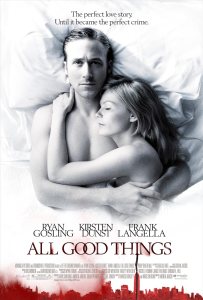
When David Marks’ (Ryan Gosling) wife Katie (Kirsten Dunst) goes missing in 1982 the prime suspect is Marks himself.
Set across the years of 1971 to 2003 All Good Things is based on the true story of real estate tycoon Robert Durst. Even more sensational than the content of this film is that it would go on to directly impact Durst’s life after it was released. But more on that later.
In 1971 Marks is a goofy young idealist. As the eldest son to a real estate empire controlled by his overbearing father he should be focusing on entering the family business, but he shuns it at every opportunity. Forced to be a temporary plumber for a new tenant he meets and falls in love with Katie and they move to Vermont and open a health food store called “All Good Things”.
However things do not turn out as they plan and eventually Marks’ domineering father Sanford (Frank Langella) gets his way and David enters the family business. The result is catastrophic for both David and Katie as their spirits are crushed, their relationship falters and eventually Katie disappears.
Perhaps the biggest flaw in the story presented on screen is that director Andrew Jarecki and writers Marcus Hinchey and Marc Smerling seem to have to tiptoe around what they want to say. With their story based on real people there is a very real sense of wanting to accuse them of murder but not face prosecution for slander themselves. The outcome is that we have a fascinating story that struggles to really say anything. It simply has to make do with insinuation.
The cast have mixed fortunes as well. Gosling struggles to nail the transformation from goofy young idealist to detached and broken possible murderer. The plot informs us of mental trauma and possible mental health issues but what we see on screen is again an insinuation of what might be. Dunst on the other hand steals the film. Her transformation is far more believable even if it does happen at break neck speed. Langella on the other hand does what he needs to do with a commanding hand. He may be playing a cliche father who only cares about business but he does so with aplomb.
The result is a misfire. An interesting story hamstrung by not being able to say what it’s thinking. Which makes the story about the film’s impact even more incredible.
Robert Durst was so enamoured by the film and the way it was managed that he contacted director Jarecki. This led to a documentary series called The Jinx released five years later which ultimately led to Durst’s arrest and conviction for murder… but not of his wife. But I will let you discover that story for yourself. I may not have considered “All Good Things” to be the best of films but there is no denying its power.
 Phil the Bear's Film Reviews
One thought on “All Good Things”