
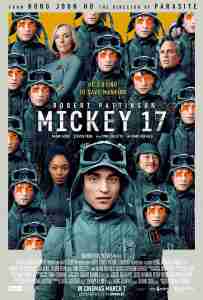
Mickey (Robert Pattinson) signs up to be an “expendable” on an intergalactic mission to colonise a distant planet.
An “expendable” is someone who has agreed that their body and memories can be uploaded for subsequent printing should they die as a result of being sent on all the dangerous missions required by the expedition. By the time the ship arrives at the planet they plan to colonise, Mickey is now Mickey 17, and a mixup that presumes him dead means that there is now a Mickey 18 on the ship as well. Which is a big problem because “Multiples” are illegal with the punishment being all versions are executed.
Mickey 17 is the highly anticipated new film from writer/director Bong Joon Ho. His previous film Parasite won four Oscars for Best Picture, Best Director, Best International Film and Best Original Screenplay at the 2020 Academy Awards. So it has been quite a long wait to see what he would do next. And the answer is a little bit of everything because there are a lot of ideas running through Mickey 17.
First and foremost the film is a wacky screwball comedy with some very dark ideas threaded throughout. Pattinson’s performance as Mickey 17 is very much of a nervous and accident prone person who helps us find the humour in him being subjected to all sorts of painful experiments.
It is then very much about identity and a sense of self. If Mickey 17 and Mickey 18 are genetically identical and have exactly the same memories are they the same person or a different person? This is explored in the manner that Mickey 18’s personality is different to Mickey 17 because he has drawn a different conclusion as to what to do based on the same information. Whilst Mickey 17 is now scared to die because he would not be reprinted as another Mickey already exists, which would mean permanent death.
There is also a big focus on the differences between the “haves” and the “have-nots” which is a common theme that runs throughout all of Bong Joon Ho’s movies. The leader of the expedition ship is a failed politician named Kenneth Marshall (Mark Ruffalo) who leads alongside his wife Ylfa (Toni Collette) and right hand man Arkady (Daniel Henshall). They lead by virtue of being backed by a religion and a political party living in far greater wealth and circumstances than the rest of the workers on the ship.
There is a focus on friendships and families made through them. Mickey’s best friend Timo (Steven Yeun) uses him at every opportunity. Whereas his girlfriend Nasha (Naomi Ackie) accepts him as who he is… each time he becomes a new Mickey.
And then there is the significant plot point around the discovery of indigenous life on Niflheim, the planet they intend to colonise.
All of which is a lot to pack into a 147 minute film!
The result is good, but dare I say it not exceptional. Perhaps on subsequent viewings there will be a vast amount of subtlety and nuance that you can absorb with an already existing knowledge of the story. But there were so many themes and plots I found myself intrigued but never satisfied with any one of them.
Ruffalo and Collette for example are giving absolutely hilarious and bonkers performances of the sorts of hideous powerful people who would run a religious sex cult and I wanted to know more.
Naomi Ackie’s character dotes on Mickey and comforts him and stays with him through thick and thin. I wanted to know more about her motivations and how that made her feel.
Mickey 18 drew different conclusions and behaved differently. What does that mean for the theory of reprinting? And why did Mickey 17 still consider Timo a friend?
There is so much here and so much to love that it is well worth watching. Perhaps the point is to leave us asking questions and promote discourse on the very many subjects it alludes to? Or perhaps I should have sat back and just revelled in the humour and performances.
Either way, check it out.

 Phil the Bear's Film Reviews
One thought on “Mickey 17”