
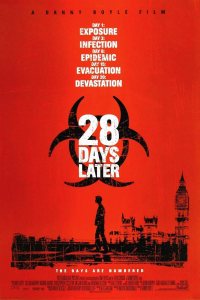
When animal activists break into a laboratory testing on chimpanzees they inadvertently release the ‘rage’ virus onto the UK population. 28 Days Later Jim (Cillian Murphy) wakes up in a hospital bed in a deserted London unaware that the apocalypse has happened whilst he slept.
As Jim wanders the deserted streets he encounters the infected and is saved by two other survivors. Selena (Naomie Harris) and Mark (Noah Huntley) bring him up to speed on the events that took place whilst he was sleeping and explain what it takes to survive.
28 Days Later still stands up as an intense and powerful film twenty-three years since its release. With a trilogy of sequels on their way depicting 28 Years Later it felt time to return to the original and its brilliance.
The film feels deliberately structured as three defined acts bookended by a prologue and epilogue. Act One is about coming to terms with the world as it has become. Desperation and nihilism have seeped in to those left alive, where there is only survival and no life. Act Two creates a family and a community from the ashes. The introduction of Frank (Brendan Gleeson) and Hannah (Megan Burns) shows Jim and Selena that there is still a reason for living and hope is important. Act Three however shows us the opposite of Act Two. It delivers the decline of society in desperate circumstances and introduces an army unit led by Major Henry West (Christopher Eccleston). One constant for the audience throughout the entire story is that of holding your breath as you find yourself on the edge of your seat waiting for the next threat to our protagonists.
The infected are petrifying. It is important to remember that these are not zombies and the creators were keen to avoid that description. It was this film that created the idea of fast moving zombies that the likes of Zack Snyder later embraced with his Dawn of the Dead remake and later Army Of The Dead. When infected it takes seconds for the virus to take hold. Turning humans into unthinking rage filled monsters that run headlong at any source of food regardless of what stands in their way.
The musical choices both amplify the threat and underline the hope thanks to a superb score from John Murphy and the usage of Godspeed You! Black Emperor’s song “East Hastings” (I highly recommend their other songs/albums as well). East Hastings and Murphy’s “In the House – In a heartbeat” amp up the dread immeasurably whilst Murphy’s “In Paradisum” provides a lilting antidote to all the fear and rage when the group have a moment of respite.
The filming also gives the film a huge amount of its character. Shot on small digital cameras to allow for speed the film makers were able to portray an eerie empty London by closing streets and roads for very short periods of time (less than an hour) and quickly getting the shots they needed. Seeing Jim wander London totally alone with its tourist landmarks in view is a hugely discombobulating effect that helps sell the story being told. Whilst the digital images give it a rougher documentary feel compared to the crystal clarity you get with digitally filmed movies today.
The performances are all perfect as well. For Cillian Murphy and Naomie Harris this was their breakthrough performance with much lower profile work on their resume before this. And they are both superb throughout. Murphy, now an Oscar winner for Oppenheimer is able to deliver a performance that is both fragile and steely. Harris on the other hand absolutely nails her delivery about killing anyone infected “in a heartbeat” and her harrowing scenes with the young Megan Burns near the end.
28 Days Later is a masterwork from writer Alex Garland (Warfare, Civil War, Ex Machina) and Director Danny Boyle (Trainspotting, Slumdog Millionaire, Steve Jobs) and it is exciting to think about what they might bring to the forthcoming sequel.

 Phil the Bear's Film Reviews