

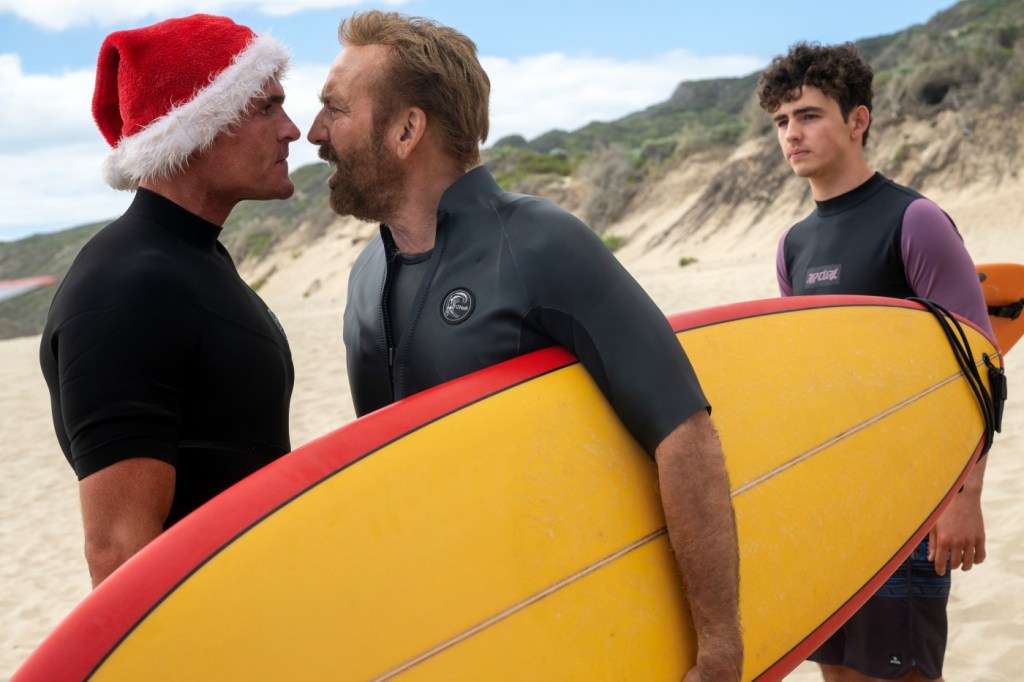
When a man brings his son to the idyllic beach that he once surfed on as a child he finds himself in an altercation with the resident surfers. They insist that surfing is for locals only and the man finds himself locked in a conflict that constantly increases in severity.
The Surfer is a film with a rather surrealistic feel designed like a 1970’s exploitation film. The characters are only known by what they are; Nicolas Cage is ‘The Surfer’, Finn Little is ‘The Kid’ and Nicholas Cassim is ‘The Bum’. Or in the case of the gang of locals threatening The Surfer, by their nickname; Julian McMahon is their leader Scally, Alexander Bertrand is Pitbull and Michael Abercromby is Curly. And the situation feels like a Twilight Zone scenario where you will have to question what is happening in the real world and what is happening in the Surfer’s mind as he finds himself seemingly unable to leave the car park overlooking the beach for days.
The storyline is not what you might expect and plays out at a pace that may test many people’s patience. This is not a violent film or a revenge rampage. This is about a man seemingly losing his mind in slow motion as he loses every physical possession making him call into question his status and sanity. It opens with The Surfer desperately trying to get his son to like him. He has taken him out of school and announced that he is buying his old childhood home in a beach community. But even before The Surfer gets rebuffed by the locals it is clear that he is hanging on by a thread. Estranged from his wife and child and desperate to somehow win them back with a last ditch effort of buying this house that meant so much to him in his past.
There are also flashes of imagery we see in The Surfer’s mind. Are they the past or the future or just the musings of a man losing his mind? There is A Bum living in a car in the car park and after some discussions with him The Surfer seems to gradually begin to become him. Is he real or imagined? Is he some part of The Surfer’s past?
And then there is the villain of the piece, Scally. A man who seems to encapsulate the Andrew Tate style ideology of toxic masculinity whose followers treat him like a God as he utters the mantra that you cannot surf unless you have suffered.
Writer Thomas Martin does an interesting job of trying to convey ideas about toxic masculinity and the need to be able to “ride the wave” of life as it throws things at you. And Director Lorcan Finnegan does an interesting job of trying to wrap those ideas up into a jumble of 1970’s exploitation film meets The Twilight Zone. And they are helped immensely by Nicolas Cage, an actor who could not be better suited to representing a man losing his possessions and his mind in an outlandish way. But ultimately the pacing of the film lets it down with it only really coming together in its closing moments.
An intriguing proposition that requires patience to get to the satisfying final moments. But you might not consider the wait worth your while.
 Phil the Bear's Film Reviews