

It is 1984 and aspiring filmmaker Julie (Honor Swinton Byrne) lives in a Knightsbridge flat with another student as she navigates film school. When she meets Anthony (Tom Burke) at a party, an older man who works for the foreign office, she is taken by his mysterious nature and begins a relationship with him.
The Souvenir essays Julie and Anthony’s romance and its title relates to the real life painting by Jean-Honore Fragonard that Anthony gives Julie a postcard of and later takes her to see. When they see the painting together Julie says the girl who is the subject of the painting looks sad, whilst Anthony believes she looks determined.
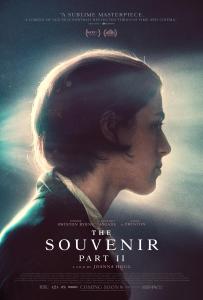
The Souvenir Part II continues the story of Julie at film school as she comes to terms with the life changing events of the original feature. Pivoting from her original idea of making her debut film about a child and his mother on the working class streets of Sunderland she decides to make it about her relationship with Anthony in an effort to understand both him and herself better.
The states of mind that Julie and Anthony relate to each other when looking at the titular painting seem to convey the mindset of Julie in each film. In The Souvenir she is sad. In The Souvenir Part II she is determined.
Unusually here I am taking the decision to review two films together which will aid me in conveying my thoughts but perhaps hinder me in my description of the plot points as I want to leave certain revelations under wraps. The reason for joining my reviews together is that ultimately these two films tell a singular story that requires the viewer to see both films. And whilst it might be possible to see The Souvenir and feel you have seen a complete story there is very little way that you could appreciate The Souvenir Part II without having seen the original.
Ultimately the main character of Julie is a cipher for the two films’ writer/director Joanna Hogg. Although as with all semi-autobiographical films the characters and events are meant to be heightened and fictionalised accounts of the creative’s life, it is very clear these films are the writer/director’s means to process the pain she experienced as a young woman.
The first place to start with my feelings on watching these two films is the massive sense of disappointment that I felt at wasting just under four hours of my life as a result of a swathe of overwhelming critical reviews telling me that these films were masterpieces. I have meant to watch these films for years as a result of a slew of five star reviews that suggested these were beautiful portraits of a young artist learning her craft and navigating life. But whilst I can appreciate the bravery of putting such an honest story onscreen and the craftsmanship on show I am here to tell you that this is essentially a middle class Ken Loach movie masquerading as therapy. Everything is so gosh darn realistic and depressing and told at a glacial pace and frankly I am not sure that I am that interested in someone living in Knightsbridge, borrowing money from her mother (Tilda Swinton) and unable to spot the signs of an obvious drug addict.
The original film is by far and away the better feature thanks to Tom Burke’s rather brilliant portrayal of Anthony. A gaslighting, coercive and manipulative asshole whom our main protagonist seems to love in the most naive and non-sexual way imaginable. It is a fairly straightforward portrayal of misplaced love and how it impacts lives. Just one that happens in slow motion and is painfully specific about just how real it can possibly be. Damn, the 1980’s in London have never looked so boring.
The second feature on the other hand is about an exploration of the impact of that love story on the lives it touched. And writer/director Hogg could not be more clear about its artistic credentials when she includes not one, but two flourishes at the end of the film that underline this. The first, a dream sequence that allows Julia to finally process everything that happens. The second, a sequence that underlines that art is a mechanism for the artist to process their pain.
If your idea of a good time are realist films set in the 1980’s that follow a middle class film student navigating her first love and coming to terms with the impacts then this will be for you. Personally I will not be returning to The Souvenir or its sequel at any point thanks to its funereal pace and overtly artistic interpretation of something that by definition should be more emotional.
 Phil the Bear's Film Reviews