
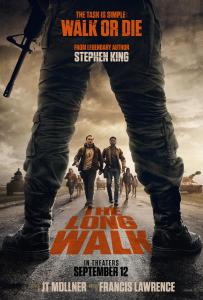
Fifty young men compete annually in “The Long Walk” to win riches and a singular wish of their choosing. Walk continuously at a speed of 3mph or be shot dead. Last man standing wins.
The Long Walk is set in a dystopian version of the United States of America now run by a totalitarian regime whose figure head is “The Major” (Mark Hamill). There are tidbits of information relating to a civil war and the suppression of “the old ways” but the focal point of the film is The Long Walk itself.
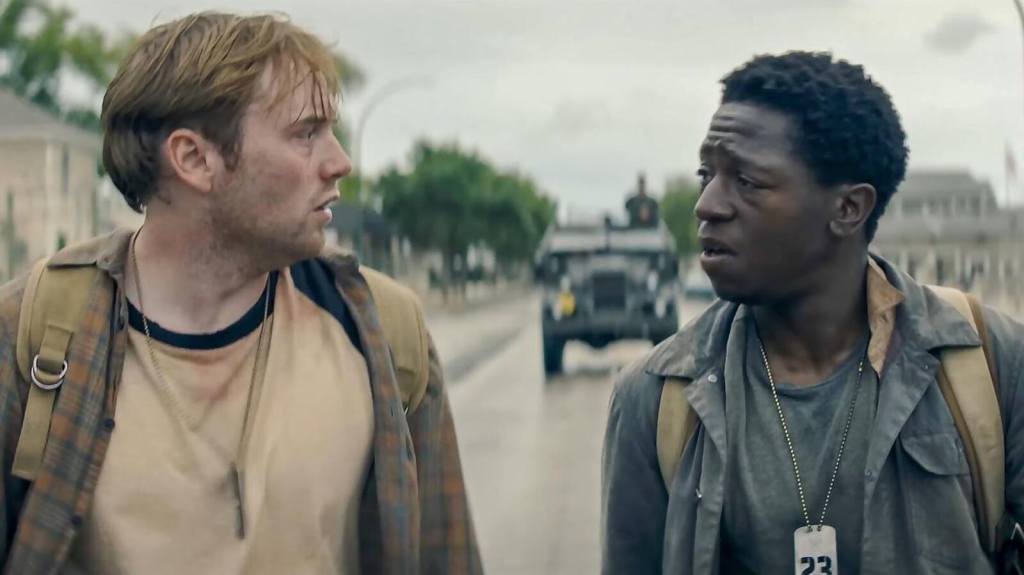
Our key protagonists are Raymond Gerraty #47 (Cooper Hoffman) and Peter McVries #23 (David Jonsson). Ray is the entrant from the home state that the walk takes place in, we meet his mother Ginnie (Judy Greer) and we see a couple of flashbacks that help explain his motivations and give some more insight into the regime that now controls America. Peter’s backstory is only given to us via his interactions with the other “contestants” but his desire to see the good in things and his support of his fellow walkers are crucial to the plot unfolding.
The Long Walk is a fascinating watch and a film that will stay with you and be rewarded by ruminating on its message for some time after. I suspect that I may find myself revisiting this one many times in the years that follow me writing this review.
On the face of it the entertainment is found in the camaraderie, stories and relationships between the boys on the long walk. There are moments of comedy, introspection, sadness and hope. The ultimate tone of the film is unendingly bleak but it is the friendships formed in the moments that matter both to the film’s characters and those watching.
Digging slightly deeper you have the mechanics of this insanely fascinating idea. Another Battle Royale or Hunger Games plot line that makes you consider the physical logistics and propaganda goals involved. The physical facets of eating, drinking, sleeping and the need to visit the bathroom are all discussed. But then so are the mental and physical tolls of such an ordeal. Whilst the motivations of the government and the way that the populace think of the event are all alluded to as well in fascinating snippets.
Digging further still and the really interesting thought to narrow in on is how could anyone subjected to this rule and this “voluntary” competition affect change? Is there a way in which individuality and freedom could use the process of The Long Walk to make a statement? Or is the power of the state and the mental and physical torture of the ordeal too much?
Cooper Hoffman and David Jonsson are superb and this film feels like the sophomore break out movie for each with Hoffman having previously stood out in Licorice Pizza and Jonsson astounding in Alien: Romulus. As they form a brotherly bond with each other and a more protective bond over some of their fellow walkers it feels like they offer a lighter and darker view of their prospects and the role of The Long Walk itself.
Other information that really lends itself to explaining why there is so much depth and precision in the story telling is the fact that this is based on a 1979 novel by Stephen King (originally published under his pseudonym Richard Bachman) and directed by Francis Lawrence who directed four of the five Hunger Games movies currently released. The script, which is incredibly faithful for a film adaptation was written by JT Mollner who recently delivered the cult classic in waiting Strange Darling as well.
The Long Walk is unflinchingly bleak but still gives a glimmer of light in the darkness and creates something endlessly fascinating.
 Phil the Bear's Film Reviews
One thought on “The Long Walk”