
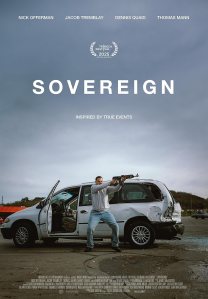
Jerry Kane (Nick Offerman) identifies as a “Sovereign Citizen” exempt from the laws of the state by virtue of the fact that he does not consent to them. Whilst travelling around the state with his son Joe (Jacob Tremblay) giving sermons on his beliefs to people in financial difficulties his views begin to radicalise even further than they already are.
Sovereign is based on a true story that occurred in 2010 in West Memphis, Arkansas where Jerry and Joe were involved in a stand off with police with fatal consequences. This film account attempts to show the events leading up to this moment and the motivations that led to it.
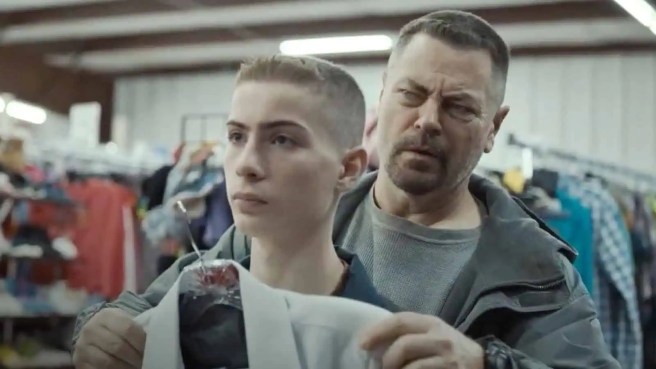
Told in the main from the perspective of Joe, Sovereign focuses on extremism and the beliefs that parents impose on their children. We learn slowly but surely the events in the life of Jerry that laid the kernels of distrust in the Government that led to full blown radicalisation of his views against them. And we see how Joe, removed from the school system at a young age and living on his own with his father admires and believes in everything that he says. But belief is starting to sway in Joe’s eyes. He is a teenager who has started to yearn for the company of others his own age and the constant stress and threat of their home being foreclosed on does make him question occasionally what his father believes.
Juxtaposed to this we see the father and son relationship between police Chief John Bouchart (Dennis Quaid) and his police officer son Adam Bouchart (Thomas Mann). With John deriding his son for picking up his crying child in the night as it just sets a pattern and beaming proudly as he learns methods for overpowering and immobilising suspects. But whilst the film is showing how parents imprint their beliefs on their children it never allows us to think these two different parental world views are similar.
Sovereign is an incredibly interesting subject matter with a lot going for it. Nick Offerman and Jacob Tremblay are incredibly good at conveying both a loving and destructive relationship. There are elements of resentment, pride and love in their characters’ interactions. It also delivers its characters’ belief systems and motivations in a thoughtful and engaging manner without hammering home the information in too obvious a manner. It is also not political in the sense of taking particular parties sides, it is just anti-authority of any kind.
Its main issues lay in its lack of urgency to tell its tale. At one-hundred minutes it still feels a little overlong as it takes a leisurely pace in telling the Kane’s story whilst arguably underusing the Bouchart police characters that would give a greater comparative plotline.
I would still recommend it just for Offerman and Tremblay’s performances and the simple fact that I was unaware of such a movement as the “Sovereign Citizens”. But be warned this is not the action feature the poster implies.
 Phil the Bear's Film Reviews