
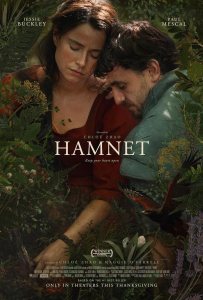
Agnes (Jessie Buckley) and William Shakespeare (Paul Mescal) attempt to process the intense grief of their eleven year old son Hamnet dying.
Opening with the moment Agnes and William meet this film plots their courtship, marriage and life together until everything comes crashing down for them with the death of their son. For me, the entire heart of the story is a scene at the beginning of the film when the pair are courting. Agnes mocks Will for not being able to express his thoughts in words given that he is a tutor of words to her brothers. Will says he is better at telling stories than speaking plainly and Agnes asks him to move her with a story. So Will tells her the story of Orpheus and Eurydice, a couple whose love for each other transcends the underworld but is ultimately doomed. When their son Hamnet dies Agnes doubts that his grief is as great as hers, so Will writes a play as a way to both honour his son and say goodbye to him.
This sounds absolutely wonderful as a concept but my thoughts on the film as a whole are mixed.
It is an acting showcase for Buckley and Mescal who deliver on many levels. They convince as young lovers rapt with each other and grieving parents unable to reconnect with each other. Buckley has been sweeping up Best Actress awards for her performance and will be a huge favourite for this year’s Academy Awards. If she wins then her back catalogue of work will certainly justify it if not this rather awards baiting performance. They are both exceptional of course as two of the best actors of this generation. And it is worth noting that there is some really sensitively done work with the young actors in the film with Jacobi Jude as Hamnet, Olivia Lynes as his twin Judith and Bodhi Rae Breathnach as Susanna.
The final scenes are a cathartic joy and would extract tears from even the hardest hearts. After so much grief it finds a wonderful way to celebrate life and suggest that our protagonists can find a way forward. Although the fact that the music choice for these final moments is Max Richter’s masterpiece “On The Nature Of Daylight” is essentially a cheat code for extracting those tears. Even if you do not think you know this piece you will recognise it.
Director Chloe Zhao is clearly a huge fan of the works of Terrence Malick but her success in mimicking his style in this film is rather hit and miss. There are many shots of nature and of the trees shot from the ground looking up. Words and sentences from characters begin on screen and then drift across other images. Handheld camera floats around not necessarily capturing everything in frame perfectly but giving the sense of spontaneity and authenticity. These moments work best in depicting the couple’s courtship but fall away afterwards. But I cannot help but feel like they are a facsimile of the real thing.
The bulk of the running time between the couple’s courtship and grief is a rather dreary and wearisome affair far too focused on Agnes’s superstitious and old fashioned ideas of healing and foresight. Something that gets tiresome very quickly and goes on far too long.
When I reviewed Zhao’s Best Picture Academy Award winning Nomadland, which also provided Frances McDormand with the award for Best Actress I described it as, “To be admired rather than enjoyed”. Hamnet may yet provide Jessie Buckley with the Best Actress award as well, but it is still hard to describe it any differently. I admire the concept and the final moments are wonderful. But my recommendation would be to seek out a Terrence Malick film.
 Phil the Bear's Film Reviews