
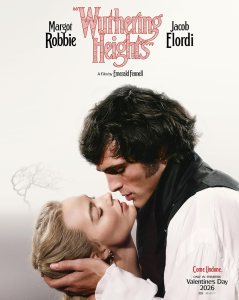
The classic story of Heathcliff (Jacob Elordi) and Catherine Earnshaw (Margot Robbie) set against the backdrop of the Yorkshire Moors in the late 1700s.
I need to begin my thoughts on writer/director Emerald Fennell’s adaptation of Emily Brontë’s Wuthering Heights with the context of my relationship with the subject matter. Immediately prior to the trailers for this film releasing, my awareness of the story was founded purely on the classic Kate Bush song and the understanding that it was a classic story of doomed romance. At the outset of this year, I decided I should rectify that by reading the novel prior to this film’s release, but for one reason or another, I found myself only just over halfway through by the time this film premiered in time for Valentine’s Day and a romantic date night.
As I read the novel, I found myself increasingly confused by the film’s advertising and indeed the story’s legend as “the greatest love story” ever told, given that I found myself reading a story about unrequited, destructive love. In fact, from Heathcliff’s perspective, it felt entirely like righteous vengeance… as well as the servant Nelly’s (Hong Chau) almost villainous scheming that destroys the families involved.
No matter, I thought. This is an adaptation in its own right, and I have enough tools to allow me to interpret it both as a film in its own right and as an interpretation. And “interpretation” is the operative word here. It is worth stating that the film’s title is to be found in inverted commas, and writer/director Emerald Fennell is quoted as saying, “I wanted to make something that was the book that I experienced when I was fourteen.” In fact, she has also said that the book is too complicated to adapt, and this is simply a version of it.
So be forewarned, as an adaptation of Wuthering Heights, this is an abject failure. If you want this story to bear resemblance to the book, you will be utterly dejected watching it unfurl. The crucial changes are that this story ends only halfway through the book (serendipitously for me, given that my reading took me beyond this point), Heathcliff is no longer of unknown ethnic origin, Catherine no longer has a brother, and his role is amalgamated with her father, Isabella (Alison Oliver) is now a ward of Edgar (Shazad Latif) and not his sister, and Fennell’s teenage fantasies lay waste to the word “unrequited”.
Similarly, if you are looking for a period-accurate representation of the story, please look away now. Catherine is no longer a Yorkshire lass and wears extravagant costumes in a gaudy world.
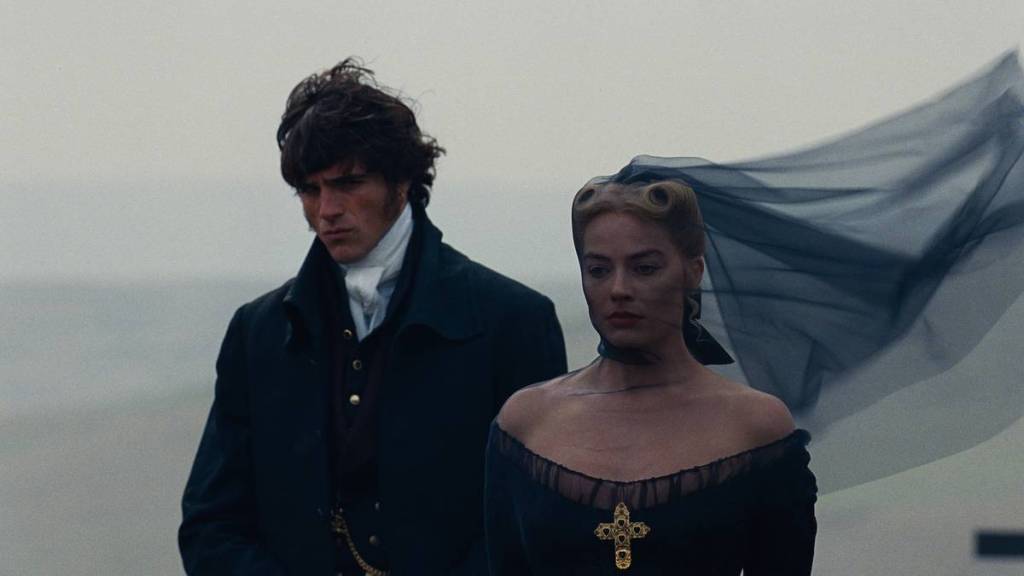
Where the film does succeed is in its visuals and music. Whether they suit your taste or not, there are some striking costumes and visual imagery to ogle at (in amongst the sweaty torsos). Catherine transitions from the plain and functional Wuthering Heights to the opulent Thrushcross Grange, where her suitor Edgar resides, and finds herself resplendent with some beautifully striking dresses. Whilst the score by Anthony Willis and original songs by Charli xcx fit the theme perfectly. I would argue that the songs “Wall of Sound” and “Chains of Love” are the artistic achievement of the project.
That visual and aural feast is unable to keep your attention though, as the film flickers and fizzles with occasional interest but is ultimately unable to maintain any continued connection.
The writing at times is cringe-inducing. Having Isabella describe Romeo and Juliet, a doomed romance where she attests that the nurse is the villain for not fully disclosing information to its protagonists early on in the film, practically gave me whiplash. Whilst the roles of Edgar and Isabella feel hopelessly miscast, although that perhaps is due to the rather odd change in their relationship. Even Martin Clunes, who rather steals scenes, is hamstrung by the fact that they have made him both the kind benefactor and primary bully of Heathcliff.
So it falls to Margot Robbie, Jacob Elordi, and Hong Chau to step in and try to save the film both in terms of sexual chemistry and deception and intrigue. All of them do remarkably well and they sometimes deliver… just not consistently for a running time of 136 minutes.
As a piece of art that prompts strong feelings, this interpretation of “Wuthering Heights” is a roaring success. As a coherent or entertaining narrative, it falters massively.
 Phil the Bear's Film Reviews