
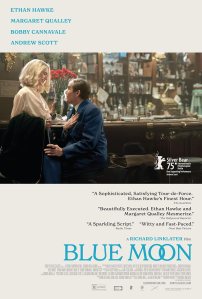
It is March 31st, 1943 and Rodgers and Hammerstein’s first ever collaboration, “Oklahoma!” has just opened on Broadway. Having just sat through the opening performance, Rodgers’ long term collaborator Lorenz Hart (Ethan Hawke) holds court at Sardi’s Restaurant with the barman Eddie (Bobby Cannavale) and the many other famous faces who venture in during the after party.
Blue Moon is an exquisitely engineered chamber piece that showcases the acting of Ethan Hawke, the writing of Robert Kaplow and the direction of Richard Linklater. Set almost entirely in Sardi’s, with only tiny bookends taking place externally this film focuses on the character of Hart, a man responsible for some of the greatest songs of all time who is mostly forgotten thanks to his partner’s even more successful later collaboration with Hammerstein.
Our every focus in the film is on Hart. The first thing we are aware of is the physical transformation of Ethan Hawke. Shaving his head in order to create his balding comb over look and the use of forced perspective and having Hawke stand in trenches to make us aware of his diminutive five foot stature compared to those around him. It is more than just a visual change as it embodies the manner in which others dismiss the man and how Hart himself often felt belittled and insecure. We are then given an insight throughout the film into how Hart thinks and it is a wonderful look into a complex man and something that will ultimately feel tragic.
Hawke is superb and lifts the film above its small independent film status. He has rightly been nominated for Best Actor at the upcoming Academy Awards. Although it is unlikely that he will pick up his first Oscar, despite this being his fifth nomination (he has previously received two nominations for supporting actor and two for writing). An oversight that needs to be rectified before his career is over.
Hart is an intellectual who considers certain things beneath him, yet is completely aware of his own jealousy that the first musical that Rodgers’ writes without him is going to be a massive hit. He is an alcoholic who knows that he should not drink but cannot help himself and smokes cigars so often he could be described as a chimney. Hart describes himself as omnisexual and is hopelessly besotted by Elizabeth Weiland (Margaret Qualley), a woman young enough to be his daughter.
The story itself is based on a series of letters written between the real life Hart and Weiland which result in something that feels incredibly personal and altogether real. In fact the conversations between these two made me feel unsure as to the nature of Weiland’s intent. Hart is clearly smitten, but Weiland gave me the impression of being either incredibly naive or incredibly manipulative. This is not the only relationship to feel well realised though. Our bartender Eddie clearly knows Hart and is torn between doing his job as a bartender and delivering the poison that is damaging Hart so much. Rodgers (Andrew Scott) also clearly loves the man but needs him to be honest with himself about how his alcohol consumption impacts their work together.
There are also some wonderful little touches relating to E. B. White and his writing of Stuart Little, a young Stephen Sondheim getting to meet a musical inspiration and George Roy Hill, a man who would go on to direct a film about a doomed bromance in Butch Cassidy and the Sundance Kid.
Blue Moon is a wonderful tragedy, as we watch in real time as Lorenz Hart’s personal and professional aspirations are crushed.

 Phil the Bear's Film Reviews