
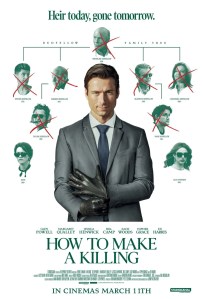
Beckett Redfellow (Glen Powell) was disowned at birth by his inordinately wealthy family following his mother’s marriage beneath her station. Despite working hard all of his life, it seems to him that wealth really does buy happiness. If only the remaining members of the Redfellow line were to die, then he would find himself incredibly rich.
Whilst instigating the murders of his remaining family tree, Beckett finds himself morally confused by some friendships he makes along the way. First, there is his Uncle Warren (Bill Camp), who gives Beckett a job following the death of his son, an act of kindness that gives him a real career and living. Then, he finds himself romantically drawn to Ruth (Jessica Henwick), who just happens to be the girlfriend of another Redfellow that needs to die. And finally, there is an old friend named Julia (Margaret Qualley), who comes back into his life. It is in these latter two relationships where the most fun is had. It reminded me of the Tom and Jerry cartoons, where the titular characters have an angel and a demon on their shoulders whispering in their ear about what they should and should not do.
The real elephant in the room in terms of how much you will enjoy “How To Make A Killing” will be in your relationship with the 1949 classic “Kind Hearts and Coronets”, the film on which it is based. In terms of characters, plot, and even the method of murder employed on the various Redfellow family, it is near identical. The problem is that in any comparison between the two, the 1949 classic is far superior. Remaking a film is not the crime many think that it should be, but remaking a classic film gives you some really big shoes to fill. Writer/Director John Patton Ford was brave enough to change the ending, though, which at least makes it of interest just to see what viewpoint he wanted to give the film.
The biggest flaw in terms of that comparison lies with the indelible performance/s of Alec Guinness in the original film. Guinness played all eight members of the D’Ascoyne family who stood in the way of that film’s lead character’s inheritance. A feat that managed to be highly memorable and incredibly comical. In How To Make A Killing, the creative team are clearly cognizant of that high watermark and attempt to make some of the Redfellow family interesting, but only two of the cameo roles really stand out. Topher Grace delivers the most memorable performance as an over-the-top charlatan priest, whilst Ed Harris delivers a steely performance as the patriarch of the family. But those big shoes I mentioned are well and truly unfilled in this regard.
Tonally, the comedy falls a little flat too. Aiming for dark comedy over farce, there are occasional moments that hit, but they are too rare. Again, a feature of this film that pales in comparison to the original.
Our lead actors both find themselves playing roles that they are dangerously close to being typecast in at this point. Glen Powell is a charmer and an everyman, whilst Margaret Qualley is the femme fatale with a sardonic wit. Both deliver in spades, but in a film that is only marginally interesting. They need to either step out of their comfort zones or find a script that lets them shine whilst offering something more than mediocrity. Powell especially needs a hit after being handed so many leading man roles in the wake of Top Gun Maverick and Anyone But You.
For those of you who have not seen the genius of “Kind Hearts and Coronets” or simply do not want to watch a black and white movie from the 1940’s, it is still hard to recommend this as a slice of entertainment. There is marginal enjoyment in the push and pull of Ruth and Julia’s influence on Beckett but in general the film just rolls from one event to the next without eliciting much emotion from its viewers.
 Phil the Bear's Film Reviews