
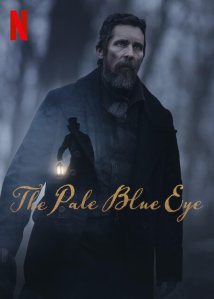
1830, West Point Military Academy, New York. When a cadet is found hanged, with his heart cut out, assistance is sought from a retired detective living locally. The gruff Augustus Landor (Christian Bale) begrudgingly sets to work, where he enlists another recruit by the name of Edgar Allan Poe (Harry Melling) to assist in his investigations.
Based on the historical fiction novel of the same name by Louis Bayard, the only thing real here is that a young Edgar Allan Poe did indeed spend some time as a cadet at West Point. Otherwise, the murder mystery with a satanic undertone is a fiction that very much plays into the legacy of the real-life Poe.
Indeed, it is Poe and the performance given by Harry Melling that make this passably worthwhile. Melling’s Poe manages to be both arrogant and kind, clever and frustrating. You will at turns consider him a suspect and a real detective and perhaps want to both hug and hit the man. Melling gives his character the kind of over-the-top eccentricity that you might perhaps expect of the author. It is perhaps the best performance from a child actor graduating from the school of Harry Potter that I am yet to see, and it is rather delightful.
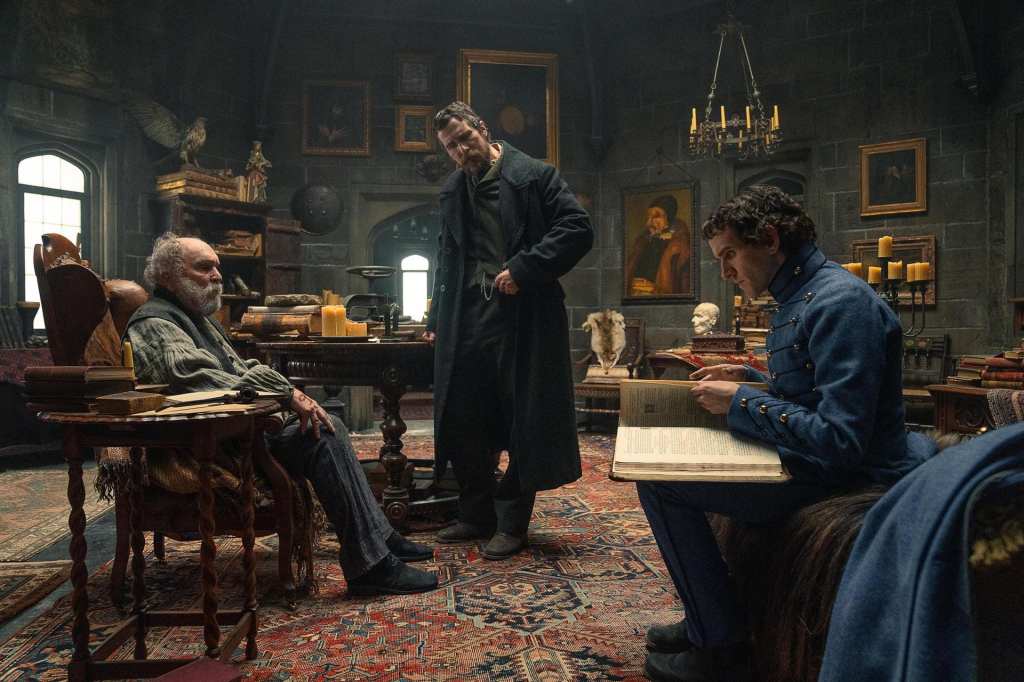
On the flip side, though, everything else feels rather staid. Chief among them is the performance of Bale and his character, Landor. Bale, in his third film for writer/director Scott Cooper, gives a typically intense performance. Landor is an alcoholic widower whose daughter has also recently gone missing. He has no real interest in the case itself, behaving generally dismissively of his employers and at times even his own self-hired assistant. There is little flair to his style of detecting and little to warm to in a man that should elicit sympathy.
Around him are a large number of British performers who give solid performances but mostly fade into the background. Simon McBurney, Timothy Spall, Toby Jones, and Gillian Anderson are all wonderful choices but are all given rather rote characters who lack any nuance or surprise. The film even features Robert Duvall in what is now his last ever screen performance, something that again rather disappears into the film rather than standing out.
Scott Cooper is an intriguing writer/director. He has wowed with the likes of Crazy Heart, which helped Jeff Bridges win an Oscar for Best Actor, and the previous two films he did with Bale, Out of the Furnace, and Hostiles. But his most recent film was the insipid Springsteen: Deliver Me From Nowhere immediately after this. There is no doubting his craft and eye; this feature looks stunning with its period setting in the snow. But he also sometimes struggles to find real passion in the stories he tells.
The Pale Blue Eye offers much but fails to deliver. Even its revelatory ending would struggle to warrant a future rewatch just to see if the clues were really there all along. Whilst scholars of Poe will at least be able to keep their ears and eyes open for references to his work.
 Phil the Bear's Film Reviews