
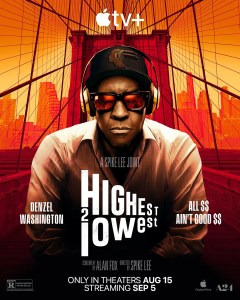
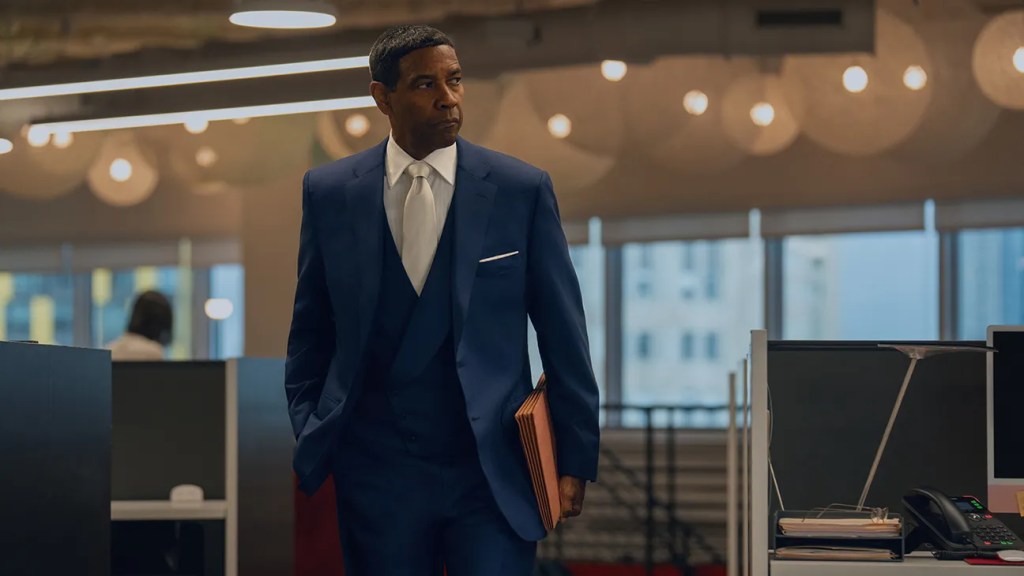
Music mogul David King (Denzel Washington) is horrified when his son is kidnapped and subjected to ransom. Faced with business and moral quandaries, he has to navigate his way through to the best possible outcome based on his moral compass.
Highest 2 Lowest is the latest “Spike Lee Joint” and his second high-profile remake of a revered Asian classic. Back in 2013, his remake of Park Chan-wook’s Oldboy was met with unflattering reviews, and given I was late to the party, only watching the original movie in 2020, I have not yet watched Lee’s version. For this movie, I am in the opposite position. I went into this unaware this was a remake of Akira Kurosawa’s 1963 film High and Low and found this film to be so shockingly terrible that I really need to watch the original.
The plot feels like it jumps around a lot, unclear of which facet of the moral dilemma it wants to focus on. It begins with Washington’s character on a mission to save his company from a buyout and take back control as the majority stakeholder. At times, this focus rears its head again alongside the issues of business versus personal life focus, with both his wife and son feeling marginalised by him in favour of his work. Then there is the small matter of the kidnap plot, which initially begins as a straightforward argument of pay the ransom or fight to find his son first. This issue is flipped though when we discover the kidnapper has mistaken King’s son for that of King’s chauffeur’s son. The question then asked is whether King is still accountable for the ransom and whether he cares about this personally or professionally?
The moral quandary and the treatment the police afford King compared to his chauffeur (Jeffery Wright) should be the crux of the story. Do rich people get better treatment than poor people? And should the person who was the target of an horrific event be accountable for the costs of it, even when the mistake is uncovered? But Spike Lee seems barely interested in this at all. Because the film simply focuses on all of the flamboyant Spike Lee obsessions with New York, whilst delivering some music video moments and asking Denzel Washington and Jeffery Wright to somehow pull the film out of the mire it finds itself in.
At its worst, you will find the only action sequence of the film interrupted by a carnival in support of Puerto Rico, featuring Anthony Ramos and Rosie Perez, and a subway train full of Yankees fans singing songs and expressing their dislike for the Red Sox. It’s a bizarre and very Spike Lee stylistic tic to focus on a celebration of the city rather than the action scene of a ransom drop.
The question you have to ask yourself is whether the stylistic sensibilities of Spike Lee will keep you interested in the rather generic throughline of the main story or frustrate you more. Without his messy signature, the moral questions posed are not suitably fleshed out enough to make any of the film interesting. With them, it makes the film a bizarre mess that keeps you watching.
The ending is also horrendously unsatisfying and ultimately feels like we are watching a rap music video and gospel music video back-to-back.
Please can someone point me in the direction of the Kurosawa film now!
 Phil the Bear's Film Reviews