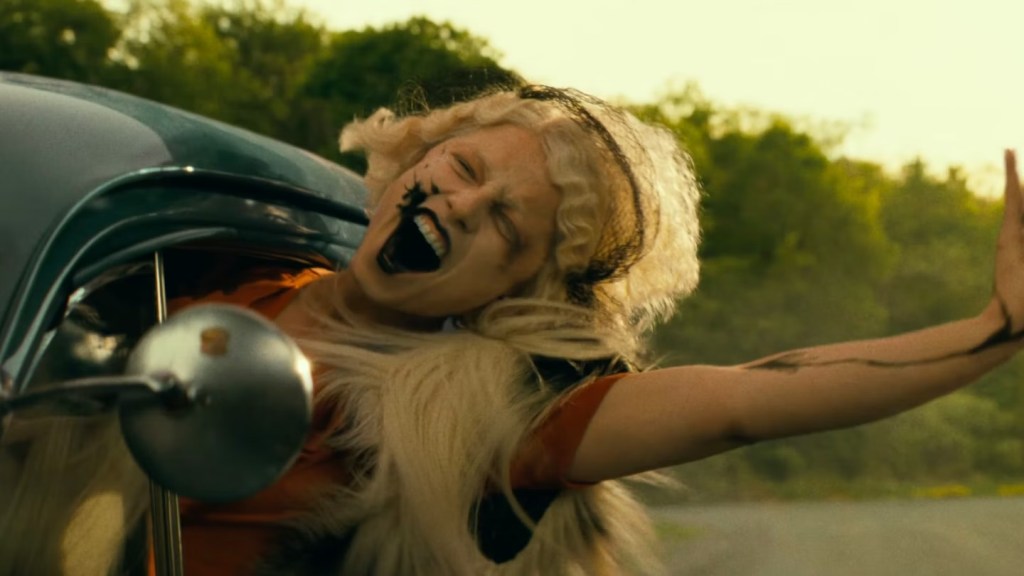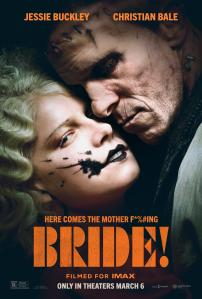
In 1930s Chicago, Frankenstein (Christian Bale) tracks down Dr. Euphronius (Annette Bening) and requests that she make him a companion. The outcome is The Bride (Jessie Buckley), who is an amalgamation of the murdered woman that she once was, the spirit of Mary Shelley, who wrote the original story, and the new creature that she has now become.
The Bride! is a very bizarre film that has some interesting parts but makes a poorly stitched-together monster of a film. Its opening gambit is to have Mary Shelley, also played by Jessie Buckley, tell us that she died too young and was unable to tell more stories. At which point she decides to enter the mind of Ida, the woman who is murdered and later brought back to life. She will later take the name Penelope and then simply The Bride! This initial focus on women being downtrodden and needing to take their power back is replicated throughout all the female characters in the film.
Mary Shelley herself is a trailblazer who decides to continue to tell her stories through Ida. Dr. Frankenstein’s mad scientist character has been gender-swapped to be played by Annette Bening’s Dr. Euphronius, and even Penelope Cruz’s character is the brains behind a detective duo where everyone just listens to the man. This plot line and theme are summed up by a poorly sketched idea that The Bride is inspiring a female revolution across the country by speaking out about the murders of women who threaten men.
Another theme it toys with relates to its film form. Frank(enstein) is obsessed with a film actor (played by Jake Gyllenhaal) who had polio as a child but is now a successful musical star. He was able to become a successful dancer thanks to shoes specially made for him to even out his legs, and Frankenstein feels an affiliation with him. As a result, we often see Frank’s view of the world through the films that he watches, meaning song and dance numbers and scenes within scenes matching the films that he loves. And whilst golden era musicals represent how Frank sees the world, the film also sees Frank and Ida/Penelope/The Bride on a crime spree akin to Bonnie and Clyde, cementing the idea of glamorous outlaws on the run.
And if that were not enough, there is also a subplot about a Chicago mob boss trying to suppress his crimes.
The result is a lot, even before we get to the performances. Everyone is dialled to eleven here. Buckley essentially plays someone with Tourette’s who has swallowed a thesaurus, switching between Ida’s 1930s Americanisms and Mary Shelley’s 1800s British. Bale, on the other hand, veers between sensitive and insane. The supporting cast, meanwhile, feels like they are in their own films. Jake Gyllenhaal plays a 1930s entitled film star well. Peter Skarsgård, on the other hand, plays the other half of the Penelope Cruz detective duo as though he specifically wants to be bad. One particular scene where he delivers a speech is perhaps the worst in the film. At least Cruz is acting equally wooden alongside him.
Writer/director Maggie Gyllenhaal seemingly had a lot to say. But it seems to me as though she might have been better off honing in on one specific thing rather than trying to do everything all at once. The result is almost like the car crash you cannot help but slow down for to see if you can make out what has happened on the other side of the road. Were it not for the fact that she can call upon so many talented individuals (including her brother and husband), this might have been unwatchable. As it stands, it’s the sort of mess that occasionally seems like a good idea.