
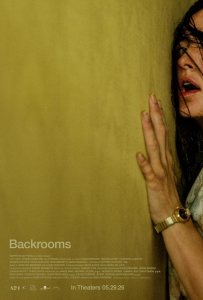
A furniture store owner named Clark (Chiwetel Ejiofor) discovers an invisible door in the basement of his shop that leads to an infinite expanse of rooms.
Clark is a lonely man who pushes everyone away. Secretly living in his furniture store because he is unable to make ends meet, he relies on alcohol as a crutch and spends his therapy sessions discussing the wife who left him. When even his therapist Mary (Renate Reinsve) refuses to believe his discovery, Clark becomes determined to prove he is right, because in his mind he is always right and nothing is ever his fault.
Backrooms is adapted from Kane Parsons’ hugely popular YouTube series, itself based on the internet urban legend that emerged around images of eerily empty spaces known as the “Backrooms”. At just twenty years old, Parsons has made the leap to feature filmmaking, and the result marks him out as a filmmaker of considerable promise.
Parsons demonstrates remarkable control over both the imagery and atmosphere. Curiously, however, despite admiring much of what the film is doing, I never found it particularly frightening. That may well be a personal response. If the idea of an endless space that feels subtly wrong taps into one of your deepest fears, this could prove far more effective for you than it was for me.
The film’s greatest strength lies in its characterisation. Clark becomes a mirror of the Backrooms themselves. Mary’s therapeutic philosophy centres on the idea that people become trapped in destructive behavioural patterns, and both Clark and the Backrooms seem doomed to repeat the same cycles endlessly.
Clark continues to push people away while obsessing over a failing business. The Backrooms endlessly expand, creating room after room that never quite functions as it should. Meanwhile, Mary is the only character actively trying to break free from her own patterns despite occasional setbacks. Ejiofor and Reinsve bring considerable emotional weight to these ideas, elevating material that could easily have felt overly abstract. It is a huge boon for such a small-scale horror film to have performers of their calibre.
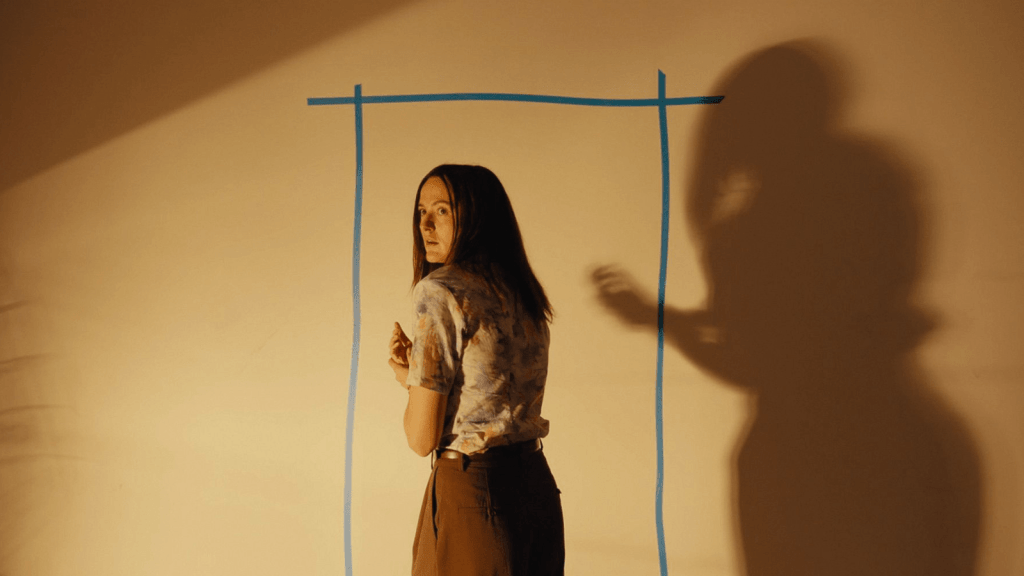
Visually, the film is quite remarkable and should linger in the memory long after the credits roll. The endless office-like rooms are bathed in a sickly yellow glow, accompanied by the incessant hum of fluorescent lighting. Yet they never quite function as they should, recalling both Alice in Wonderland and an M. C. Escher illustration. Furniture appears partially absorbed into floors, doors open from impossible locations, and every corridor stretches onwards into infinity.
The imagery is undeniably unsettling, but unease and fear are not necessarily the same thing. Because the film offers little sense of consequence or threat, I found myself admiring the Backrooms rather than fearing them. Parsons succeeds in creating something genuinely disconcerting, but for me that never translated into genuine terror.
It may be too early to place Parsons alongside filmmakers such as Robert Eggers, Jordan Peele, and Ari Aster, but Backrooms suggests a director with a distinctive visual imagination and a clear understanding of atmosphere. Even if it never truly frightened me, it remains an intriguing and often impressive debut feature from a filmmaker whose future work will be well worth watching.
 Phil the Bear's Film Reviews