
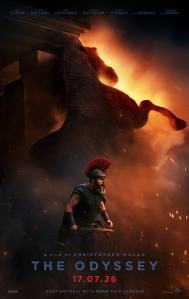
After the Trojan War, Odysseus (Matt Damon) faces a perilous journey home to Ithaca, where his wife Penelope (Anne Hathaway) and son Telemachus (Tom Holland) are desperately holding off suitors to his throne.
Christopher Nolan is known for epic scale and scope in his movies, so perhaps he is best equipped of all people to take Homer’s ancient and epic 12,209-line poem and adapt it into a story that takes on the concerns of our current age. With The Odyssey, Nolan has combined his technical mastery, his ability to adapt a story by keeping its core whilst imbuing it with new meaning, and his talent for eliciting powerful performances from a huge cast to deliver one of the most spectacular cinematic experiences you can experience.
Nolan’s use of time is often a core storytelling mechanism in his films and The Odyssey is no different. Utilising the fact that The Odyssey was a poem that would have been passed down via the oral tradition, Nolan has the story told through a series of nesting flashbacks that come from the memories of people who witnessed events and each have different perspectives. This idea is most beautifully realised in the manner in which we do not truly understand the events of the Trojan War until we witness the key protagonist remember his experiences. As with all good storytellers though, you will never be unsure of which part of the timeline we are in, mostly aided by the length and greyness of Odysseus’ beard.
Across its nearly three-hour running time we witness two major interconnecting storylines. Odysseus’ ten-year journey home sees him and his crew facing many roadblocks and challenges from the Gods. From encounters with a Cyclops, Giants and a Witch to a journey into Hades itself and a decision over the lesser of two evils that Odysseus knows will lead to death, we gradually come to understand the motivations behind his actions. Back at home in Ithaca, Penelope and Telemachus attempt to hold onto their hope that Odysseus is still alive and will one day return. But it is becoming harder for them to stave off the machinations of Antinous (Robert Pattinson), a suitor prepared to dispatch Telemachus in his efforts to marry Penelope and take the throne of Ithaca. This story focuses on Penelope’s strength, Telemachus’ coming of age and an unknown fear of “Sea People” who have been raiding islands and coastlines, bringing ruin with them. Both stories are woven together beautifully in a manner that creates an expansive and rewarding story arc.
Technically, the film is astonishing. The combination of its IMAX aspect ratio, cinematography, editing, special effects and score make it a truly spectacular experience. Jennifer Lame’s (her third Nolan film) editing creates coherence within the vast scope, Hoyte van Hoytema’s (his fifth Nolan film) cinematography captures both the vast and the intimate, and Ludwig Göransson’s (his third Nolan film) experimental score helps project the huge mythical moments into the stratosphere. The blend of practical and visual effects also does a wondrous job of bringing the mythical to life. A subtle example of all of this coming together is the armour of King Agamemnon, something that sets him apart from all of the other soldiers and makes him other to them. The moment he removes it he is no longer quite as formidable. On the other hand, you have the genius of the blend of puppetry and performance that brings the Cyclops to life, or the outright CGI spectacle of the monstrous Scylla.
Of course, all of that technical wizardry would mean very little without performances capable of matching it, and there are almost too many worth raving about.
Matt Damon, making his third appearance in a Christopher Nolan film but his first as the director’s leading man, is superb as the focal point and protagonist. His Odysseus is a man of great character who carries a huge burden as he attempts to make his way home whilst keeping his crew alive. But there are so many supporting performances that stand out as equally superb. Anne Hathaway provides huge intensity and passion as Penelope. Tom Holland brings just the right level of naivety as he seeks news of his father. Robert Pattinson chews the scenery as the dastardly suitor to Ithaca’s throne. Zendaya does wonders with very little screen time as the Goddess Athena. Charlize Theron delivers yearning and defeat as Calypso. Elliott Page gives real meaning to Odysseus’ pain as the soldier Sinon. Himesh Patel portrays Odysseus’ honourable second-in-command, whilst Samantha Morton delivers something particularly special and horrific as the witch Circe. There are many more performances worthy of mention, but I have perhaps already gone on long enough. Nolan’s ability to attract so many talented actors to deliver superb performances in roles with relatively little screen time is quite special.
There has already been so much commentary on how good an adaptation this film might be, but the key thing to my mind is that Nolan has done exactly what he should. He has taken Homer’s text, preserved its heart and adapted it in a manner that allows it to speak to a modern audience. The result is that Odysseus’ drive and motivations have a different flavour, but the perils he faces are the same and the outcome is one that resonates greatly.
The Odyssey has all the hallmarks of a Christopher Nolan movie while remaining remarkably faithful to the spirit of Homer’s epic. Rather than simply recreating one of literature’s greatest adventures, Nolan has found a way to make it resonate with a modern audience without losing what made the original endure for thousands of years. That is what great adaptation should do.
 Phil the Bear's Film Reviews