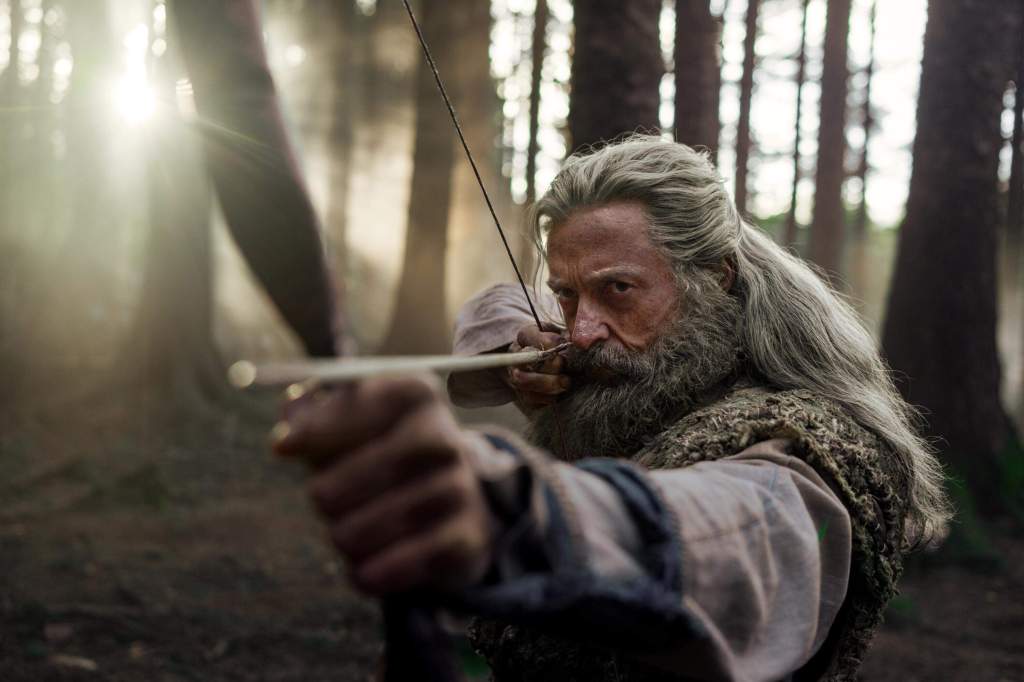
1247, England. The legendary Robin Hood (Hugh Jackman) struggles to reconcile with a past that is constantly bringing people filled with vengeance to his doorstep. One final battle leaves him on death’s door and brings him to a Priory where Sister Brigid (Jodie Comer) tends to his wounds. Will she also be able to save his soul?
The Death of Robin Hood seeks to tell a very different story to the legends we are used to hearing and it successfully obliterates the idea that Robin was good at heart within its opening twenty minutes. In this tale Robin is nothing but a thief and a murderer, his stories having grown in the telling to give hope to a downtrodden populace.
When we meet Robin he is hiding in the wilderness, dispatching all those seeking revenge for the murders he has committed over the years. Visited by his old friend Little John (Bill Skarsgard), he receives an update on the demise of what used to be his band of merry men. John, now living as Edward, asks him if he will help him with one last fight and it is here that we truly see the character of this Robin Hood.
This opening section of the film is utterly brutal and reminded me of Robert Eggers’ The Northman. These fight sequences are about survival at all costs and spare no sentiment in their representation of Robin’s brutality. This Robin Hood is about as far from those played by Errol Flynn or Kevin Costner as it is imaginable.
What follows, however, is slow, reflective and meditative. The story from this point is about an old man, tired of his violent life, learning to let go. Unable to make up for the sins of his past, he has to decide how he wants to forge a path forwards. Along the way he is assisted by Sister Brigid, a leper (Murray Bartlett) and a young girl (Faith Delaney), who both call the Priory their home.
This is writer/director Michael Sarnoski’s third feature film, following Pig and A Quiet Place: Day One, and it is clear that he has a particular skill at dealing with protagonists facing inner struggles. Hugh Jackman does a particularly good job here at delivering a character who is both reprehensible and sympathetic. In fact, it is incredibly similar to his performance as Wolverine in Logan in the manner in which he befriends a young girl who helps to keep him grounded in his humanity. All three of his films focus on a much more personal story reflecting on a past the protagonist is not proud of, a future that is increasingly short, or both.
The standout contribution to the film is the score from Jim Ghedi, his debut film score. It provides a haunting, string-led soundscape that taps perfectly into the brutal fight scenes, the more meditative reflections on life and the acceptance of learning to let go. It reminded me of the sublime musical acts Godspeed You! Black Emperor and Esmerine.
I suspect that this version of Robin Hood might not be for all. The extremes of violence followed by slow reflection may alienate some, whilst the idea of dismantling a beloved myth might rankle others. Personally, I found the experience a rewarding and fascinating watch.
Seek this out with an open mind and you may find yourself rewarded.