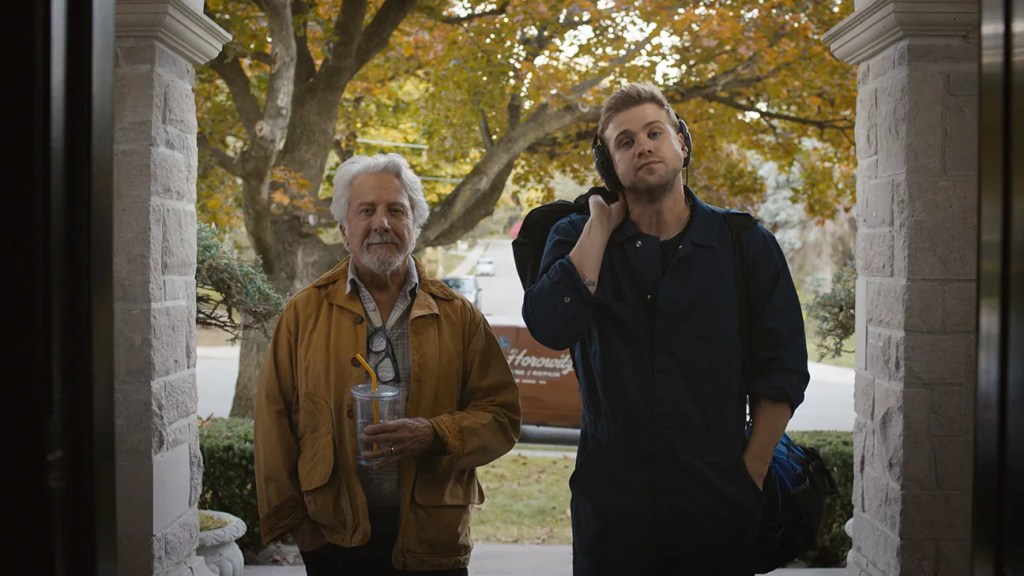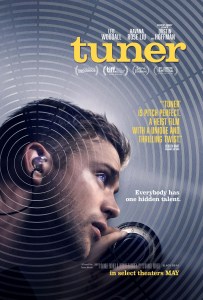
Niki (Leo Woodall) works as a piano tuner for his mentor and friend Harry (Dustin Hoffman), so when Harry suffers a health crisis that he cannot pay for, Niki uses his hearing disorder for nefarious means as a safe cracker to fund his treatment.
I want to say upfront that Tuner is a cracking film (pun intended) and one well worth seeking out. It feels like a good old-fashioned crime movie in the vein of The Thomas Crown Affair or Thief, and it thrives on its characterisation, performances and the fact that its central interest is the relationships between the characters rather than the criminal elements. But it works so well because those thriller elements put pressure on the relationships that Niki needs so much.
The crime genre elements of the film are that Niki’s hearing disorder, Hyperacusis, whilst inflicting great pain on him when subjected to loud noises, also gives him the rather superhuman ability to hear the inner workings of a safe. A series of coincidences therefore leads him down the path of assisting some rather untrustworthy types in order to make a quick dollar. But once you start down this path, can it ever really be kept separate from the rest of your life?
Where the film truly thrives, however, is in the characterisation of Niki and his key relationships with his friend Harry and the potential love of his life, Ruthie (Havana Rose Liu). The film opens with a montage of Niki and Harry during a working day, and it’s a glorious start. We immediately understand the bond between them. They are not related by blood, but they are family. Niki is withdrawn with most people, but not Harry. There is a deep love for this irascible old man that is reciprocated completely.
Niki’s relationship with Ruthie, on the other hand, begins incredibly tentatively as he slowly learns to open up to someone else. The shared love of music between the three of them is what binds them together, but Niki has lost his ability to perform, whilst Ruthie stands on the verge of achieving everything he once wanted. It is one of the most believable relationships I have seen on screen for some time, and the film takes great care in navigating the emotional tensions that naturally arise from that dynamic.
The result, performance-wise, is rather wonderful. Leo Woodall has been on the verge of breaking through as a star recently, but this is the film that should serve as his calling card. He portrays a real sense of pain for what his character has lost, whilst also conveying the love and hope that exists in his relationships with Harry and Ruthie.
Dustin Hoffman is, of course, a safe pair of hands in this sort of role, and it is great to see him on top form again. Watching Hoffman here reminded me of the veteran performers who have often helped elevate promising debut filmmakers. Just as Harvey Keitel did for Quentin Tarantino in Reservoir Dogs or James Caan for Wes Anderson in Bottle Rocket, Hoffman lends warmth, experience and credibility to Daniel Roher’s first feature.
Roher’s documentary background may explain why the film’s greatest strengths lie not in its criminal mechanics but in its people. The ideas of familial love, losing something you have always wanted, and finding people who accept you and make you feel like you belong are the emotional core of the film. Roher understands that these relationships deserve the lion’s share of the focus, and the result is a crime thriller with considerably more heart than most.
That is not to say that the thriller elements are not effective. There is huge technical craft on display throughout. Montages are used to communicate large amounts of information economically, whilst quirky camera angles make both the piano tuning and safe-cracking sequences fascinating to watch. The film cleverly presents them as parallel disciplines, intricate technical activities that require both precision and a touch of magic.
Most impressive of all is the sound design. In a film built around a hearing condition, there is naturally a great emphasis on placing the audience inside Niki’s head. The result is an immersive experience that helps us understand both the gift and burden of the way he hears the world.
My criticisms are minor. There is perhaps one coincidence too many within the criminal plotline, and arguably the ending feels slightly rushed. But when everything else works this well, these are flaws that can easily be forgiven, particularly in a debut feature.
In lesser hands, the idea of a piano tuner using a hearing disorder to crack safes could have felt absurd. Tuner succeeds because it never loses sight of the people behind the premise. The crime story may draw you in, but it is the relationships that will stay with you long after the credits roll.