

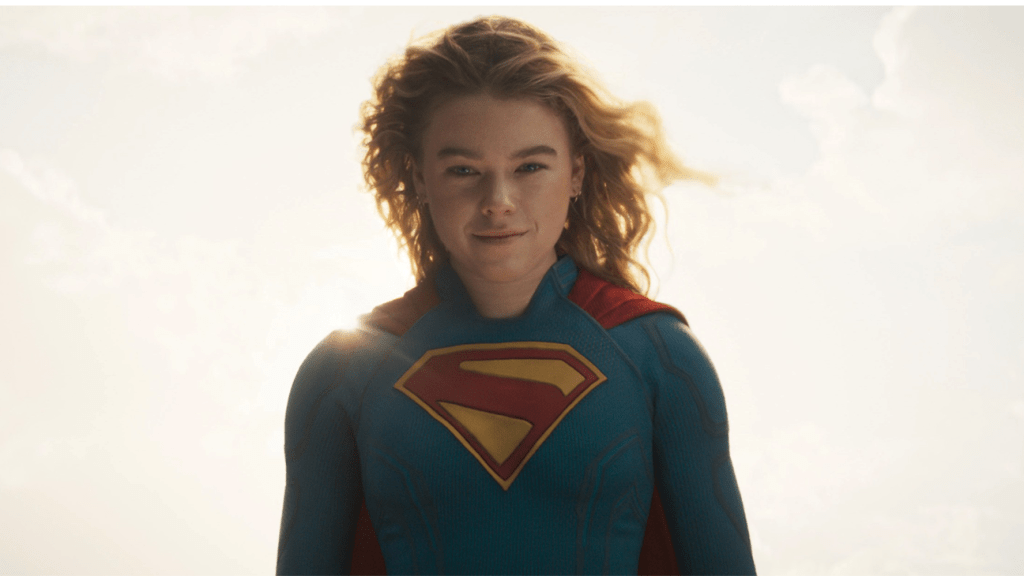
Kara Zor-El (Milly Alcock), also known as Supergirl, is celebrating her twenty-third birthday. That is until Ruthye (Eve Ridley) walks into the bar she is celebrating in, asking for help to avenge her murdered family, whilst the villainous Krem (Matthias Schoenaerts) poisons her dog, Krypto.
The immediate thing that sticks out with this iteration of Supergirl is that this is a grungier, darker vision in comparison to last year’s Superman, which was bright and hopeful. The key line uttered by our lead protagonist is that “he sees the good in everyone, and I see the truth.” In fact, calling this a birthday celebration is rather generous. Supergirl spends most of it drinking herself into oblivion, desperately trying to numb the pain of a life that has never quite recovered from the destruction of Krypton.
The idea is that this will be a dual coming-of-age story in which both Supergirl and Ruthye learn how to process the loss of their respective families without losing themselves to grief and revenge. It acts as a fascinating juxtaposition to Clark Kent, whose upbringing by a loving family allowed him to become the beacon of hope and goodness we met in Superman. It is a genuinely compelling idea, but unfortunately one that is only partially realised because Supergirl ultimately becomes a generic and rather forgettable superhero film.
There are, however, some genuinely interesting facets of the film that make it worth watching. Firstly, there is the central casting of Milly Alcock. She gives a wonderfully nuanced performance, portraying a version of Kara who is neither cynical nor optimistic, but simply damaged. She also shares effortless chemistry with David Corenswet, whose brief appearances as Superman become some of the warmest moments in the film. Clark’s gentle concern for his cousin, checking in without smothering her, says more about both characters than pages of exposition ever could.
The film also spends welcome time exploring Kara’s memories of Krypton, giving us glimpses of a civilisation already collapsing around her. These flashbacks not only enrich the mythology but also help explain why Superman and Supergirl view the universe through such different lenses. Together, these moments provide the emotional grounding that Kara’s story desperately needs.
The problem is that almost everything surrounding those ideas feels underdeveloped.
The supporting characters never become more than the functions they serve within the plot. Ruthye should provide the emotional backbone of the story, but beyond wanting revenge for her murdered family, we learn remarkably little about her, leaving Eve Ridley with frustratingly little to work with. Krem fares even worse. Matthias Schoenaerts is a wonderfully charismatic actor, yet here he is reduced to little more than a generic villain whose defining characteristics appear to be leather clothing and metal studs in his face. It is difficult to understand why an actor of his calibre was cast when the role gives him so little to do.
Then there is the extended cameo from DC fan favourite Lobo, played by Jason Momoa. He largely seems to have wandered in from an entirely different film, spending much of his screentime shouting “oh yeah” and reminding comic book fans that he exists. It feels less like a meaningful introduction and more like a teaser for something else.
If that was not disappointing enough, this is a summer blockbuster without a single truly memorable action sequence. Even the inevitable slow-motion sequence accompanied by a classic needle-drop never quite lands. More surprising still is how little humour the film manages to generate. Given Craig Gillespie’s track record with films such as I, Tonya and Cruella, where he so skilfully balanced dark comedy with emotionally complicated female protagonists, I expected much more personality than this.
There is enough talent here to suggest that a much better film was waiting to emerge. Alcock is excellent, the central thematic contrast with Superman is genuinely intriguing, and the glimpses of Kryptonian history are some of the most interesting world-building the new DC Universe has offered so far. That is ultimately what makes Supergirl so frustrating. It does not fail because it lacks good ideas, but because it never quite knows how to make the most of them. The end result is generic rather than distinctive.
James Gunn’s plan to give each DC film its own distinct identity remains an exciting one, and with Clayface next on the horizon, there is every reason to remain optimistic. Hopefully, future instalments can match ambitious ideas with equally memorable execution.
 Phil the Bear's Film Reviews