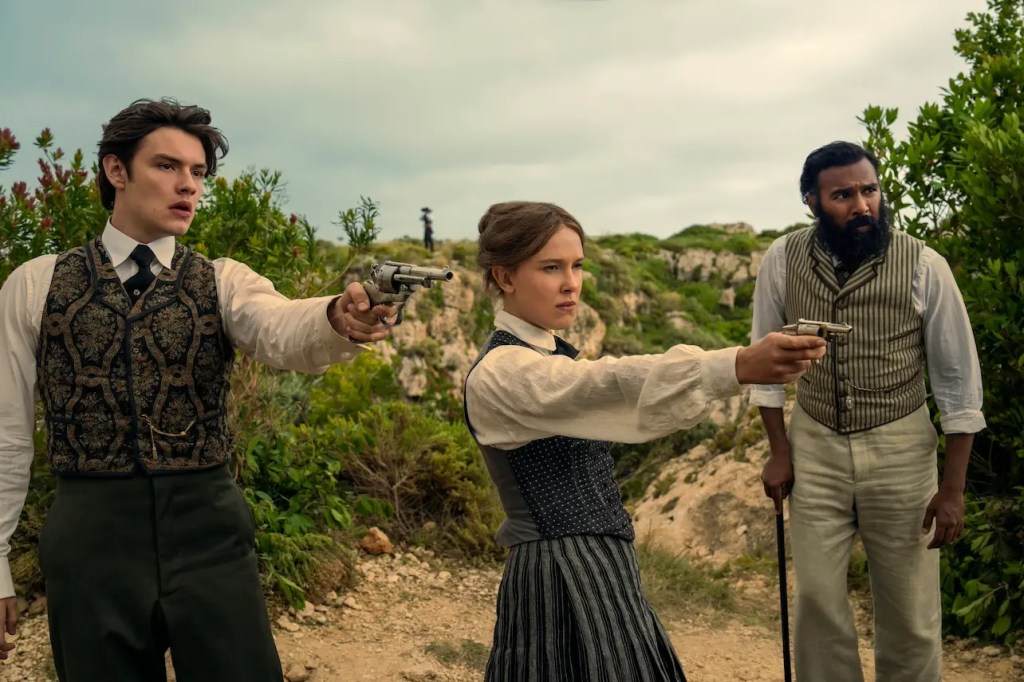
Whilst suffering cold feet over her impending marriage, Enola Holmes (Millie Bobby Brown) discovers that her brother Sherlock (Henry Cavill) has been kidnapped, setting her on her most dangerous case yet.
With the action relocated from London to Malta, the latest Enola Holmes mystery focuses on the ills caused by colonialism and what it means to build a reputation on your own name or inherit a tarnished one.
Many familiar faces return for varying lengths of time, but this time the supporting character making the biggest impact is Dr. Watson (Himesh Patel), whose Indian roots, personal perspective on colonialism and army service make him the perfect vehicle through which writer Jack Thorne, who has penned all three films, explores these themes.
The result is a perfectly enjoyable caper that also demonstrates the law of diminishing returns. Some of the changes freshen up the series, while others come at the expense of what made the earlier films so charming.
The most well-drawn story element is the idea of a name and a legacy. Enola feels as though she has finally earned the Holmes name. She is an independent woman and a fully fledged detective. The prospect of marriage and giving up her name therefore feels like the potential loss of everything she has worked so hard to become. Conversely, her fiancé Tewkesbury (Louis Partridge) learns more about his father and the legacy of his family name, one that helped shape the British Empire. This naturally feeds into the film’s wider exploration of colonialism, although it remains very much a PG-13 interpretation of those ideas and consequently feels a little lightweight.
The story itself is more thoughtful than it first appears, but the film rarely gives those ideas room to breathe. Everything unfolds at an almost permanent breakneck pace, almost as though the filmmakers are nervous about letting the audience dwell on the typically twisty plot. As a result, the playful fourth-wall-breaking humour loses some of its impact because we are constantly being rushed towards the next revelation. I have always felt the joy of these films lay in Enola’s frothy, light-hearted habit of staring directly into the camera and giving the audience a knowing wink. Perhaps that change in tone is a consequence of Philip Barantini stepping into the director’s chair to replace Fleabag director Harry Bradbeer.
Where the film is flawless, however, is in its locations, costumes and camera work. Shot largely on location in Malta, it features wonderfully bright imagery, glorious buildings and landscapes, giving the film a genuinely different feel from its predecessors. The costumes are equally spectacular, adding another layer of richness to the production.
I loved the first film; it felt like a breath of fresh air. The second was enjoyable, but already showed signs of repeating itself. Here, the changes both add (the locations and visual splendour) and detract (the pacing and loss of some of the series’ playful charm) in equal measure. The changes are enough to keep the series feeling fresh, but not all of them improve it. Enola Holmes 3 is still an enjoyable mystery, even if it never quite recaptures the effortless charm of the original.