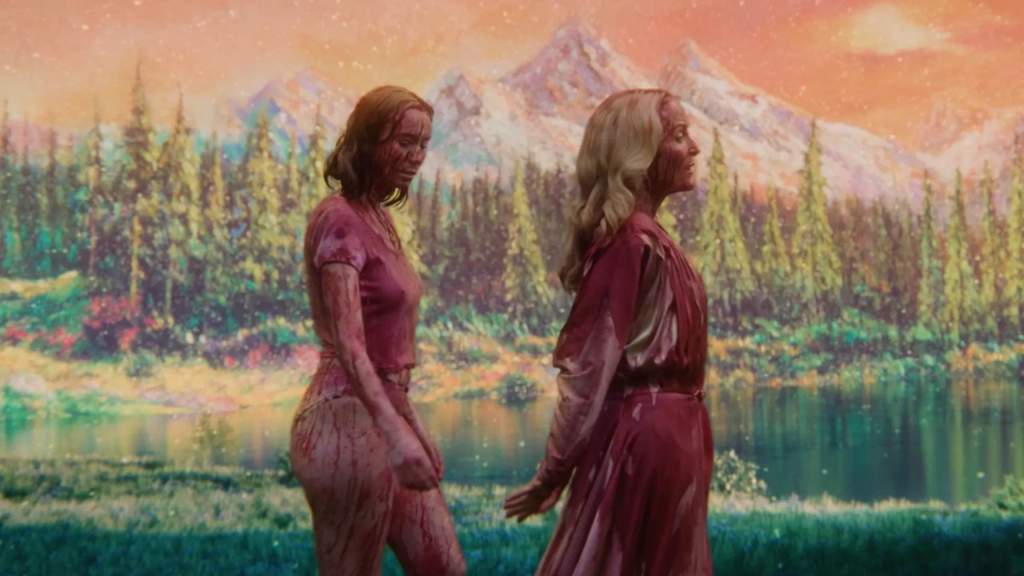
Film director Kris (Hannah Einbinder) seeks out the original scream queen of a horror franchise she has been asked to reboot, hoping to cast her in her reinvention of the series. Finding Billy (Gillian Anderson) living in the holiday camp where the original film was made is just the tip of the iceberg in how weird things are going to get for both of them.
Straight out of the gate, I am going to say that I wanted to love this movie. And oh, there is so much to love. But by the halfway point, I realised that this is less a horror film than a deconstruction of the genre, and that its true message was unlikely to resonate with me on an emotional level. The result was that I could intellectually appreciate it rather than be emotionally moved by it. Its abandonment of any semblance of horror in favour of a meta take on queerness and its representation in the genre also meant that I never felt I was going to be scared.
Let’s start with the purpose of the film. Historically, horror movies have treated the queer community poorly, with monsters and villains often associated in some way with queer traits. Yet those communities have also found kinship with the genre because of its relationship with feeling other. Writer/director Jane Schoenbrun has expertly created a film that dissects this contradiction. Her main character is queer and acutely aware that she has been asked to reboot the franchise because of that fact. It gives the studio the ability to say they have picked a younger voice with a different viewpoint, and she wants to exploit that to her own ends.
It is an insanely difficult balancing act that is pulled off rather expertly. The film opens with a wonderful credits sequence that charts the fictional movie franchise and its villain, “Little Death” (an allusion to the French euphemism for orgasm, la petite mort). It is a visually wonderful sequence that reverently alludes to multiple franchises and shows a real passion for the genre. The setting of the fictional summer camp is recreated with obviously fake sets and matte paintings that lovingly resemble horror film tropes. Meanwhile, the scream queen Billy is knowingly likened to Norma Desmond from Sunset Boulevard. Not quite a horror movie, but certainly another allusion to Hollywood and its trope of the crazy actress.
The duality of these themes is brilliantly handled. But once reality and fiction start to blur, all semblance of horror is thrown out of the window in favour of metaphor and meta commentary. Perhaps that is a minor failing in the service of the message being conveyed, but it is a huge one for a film that is ostensibly a horror movie.
Performance-wise, Einbinder is solid, but she is eclipsed by Anderson, who is having the time of her life as the film star anyone would be obsessed with. Her character may very well be insane or divinely blessed with foresight. Either way, she is hard to take your eyes off.
If these themes and this story speak to you, then this might well be a transcendent experience. Otherwise, this is an intellectually clever deconstruction of the genre rather than a film that delivers on its horror credentials.