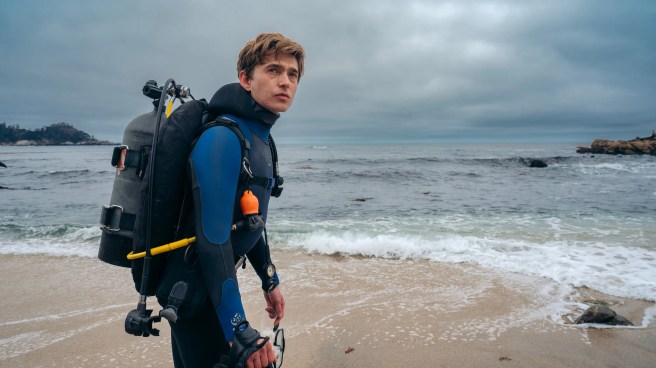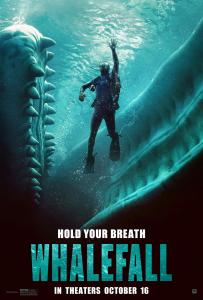
One year on from his father’s suicide, Jay Gardiner (Austin Abrams) descends into the waters where his father was last seen. His efforts to find him are interrupted when he is swallowed by a sperm whale, leaving him in a fight for survival.
Whalefall, adapted from Daniel Kraus’s popular novel by writer/director Brian Duffield, is an intriguing survival story that uses the unbelievable physical traumas of trying to survive inside a whale’s stomach as a metaphor for the much more realistic psychological trauma of a young man trying to escape the shadow of his domineering father. It is a particularly unique storytelling conceit that deserves plaudits for the extremes it explores on a blockbuster scale.
Those two extremes are the perils of the whale’s internal systems, with sequences playing out almost like a survival horror film, and the flashbacks in which we see Jay’s father, Mitt (Josh Brolin), berating him about the natural world and his need to learn all about diving.
Through these flashbacks, we learn that Mitt is a legend in the local area. A man who has dedicated his life to diving, he is disgusted by the way whale tourism destroys the natural order. Whilst he dotes on his wife and daughters, he pushes his son hard. Who else is there to learn his ways and carry them on? But when cancer takes away his ability to breathe normally, and therefore his ability to dive, Mitt chooses to end his own life, selecting his final resting place in the waters where the whales roam.
These scenes are the most moving in the entire film, as Josh Brolin delivers a nuanced performance as a father who loves his son, despite clearly understanding the damage he is doing to him. If there is a villain in Whalefall, it is Mitt.
The survival element takes us on an internal journey through the whale. Toxic, unbreathable air places a timer on Jay’s efforts to escape, whilst stomach acid, crushing stomach muscles and other swallowed sea creatures pose innumerable risks. The film manages to deliver frights through both the vast, unknowable expanse of the ocean and the claustrophobic, crushing confines of the whale’s insides. Austin Abrams appeared in an actual survival horror film this summer in Resident Evil, yet Whalefall at times feels somehow more brutal and more fantastical.
Despite these two elements of the film meshing quite well, I still felt somehow flat by the time it reached its conclusion. This is not a feel-good film by any measure. It is filled with contradictions that challenge the conventions of standard blockbuster fare: the beauty and brutality of nature, and the love and damage a father can inflict on his son. It is the balance of those contradictions that makes Whalefall hard to swallow.